
Mimi Kunz is a poet and visual artist who explores moments of liveliness and connection in few lines. Her poems and ink paintings appeared in Ink Sweat & Tears, tsuri-dōrō, Hedgerow, La Piccioletta Barca, Speculative Books, MoonPark Review and Ellipsis. Her writing was nominated for a Pushcart Prize and shortlisted for the Bridport Prize. Her first collection ‘Mother Tongue’ is coming out this year (The Kyoudai Press). It tells the story of her daughter’s first year of life, discovering the body as our mother tongue. Mimi lives in Brussels with her family.
1. How has motherhood impacted your process? This can be both your writing and your visual art.
I didn’t expect to be so productive when becoming a parent, in fact, I was rather scared I wouldn’t have time to work. In art my theme has long been body language — and living with a newborn was incredibly inspiring, as every communication is physical. I started painting the images I collected while spending time with Iris. When a friend asked me “So what’s it like, this love?” a few weeks after she (now almost 5yo) was born, the answer came in the form of poems.
I write a lot while walking now, or in these between-wake-and-sleep moments that time with a baby brings with it (I am experiencing this phase again now, as I have a 5 months old).
Overall motherhood has the effect that I can do in an hour what I used to do in a day, I don’t wait for a perfect moment.
And I found that writing and art keep me sane, they’re like a room of my own in a time when I’m rarely alone. Likewise, being a parent brings in so many universal themes in a very sensual way that I feel like my work grew in terms of content.
Wise Eyes


2. What do you think are the perceptions of parenthood within the art world?
I’m glad you ask. I sometimes wonder what it would be like if men could give birth. If we’d think of male dad artists as the ultimate creators? Isn’t it funny that women can choose to grow (a) human being(s) in their body, and yet there seem to still be hesitations about us being able to do our work once we’re parents?
I’m really happy to be part of this generation as images of a creative genius living all alone and waiting until the muse visits him are slowly fading. Thanks to Hettie Judah, Barbara Hepworth and many others taboos are lifted, artists become mothers more easily, and motherhood/parenthood is a theme in art, in all it’s facets. It becomes more accessible, thanks to women and other feminists working in the field, to have a good art career and a family. However, we need to ask for it, and insist.
At one exhibition where the Mother Tongue book was presented, an older artist (she has grandchildren already) came to me and said she loved that I included this theme in my work, that it meant a lot to her to have it expressed through art, that she thought it was bold, that it wouldn’t have been possible when she was my age.
Many contemporary artists like Eleanor Shipman are working on sharing the many facets of parenthood through their work, and as many art lovers are parents too, there is a natural audience and a conversation across generations.
I think becoming a parent made me a better artist and being an artist makes me a better parent. I take my girls along to exhibitions and readings when it suits their rhythm, and I’m lucky to be part of a network where many artists are also parents.
New Moves

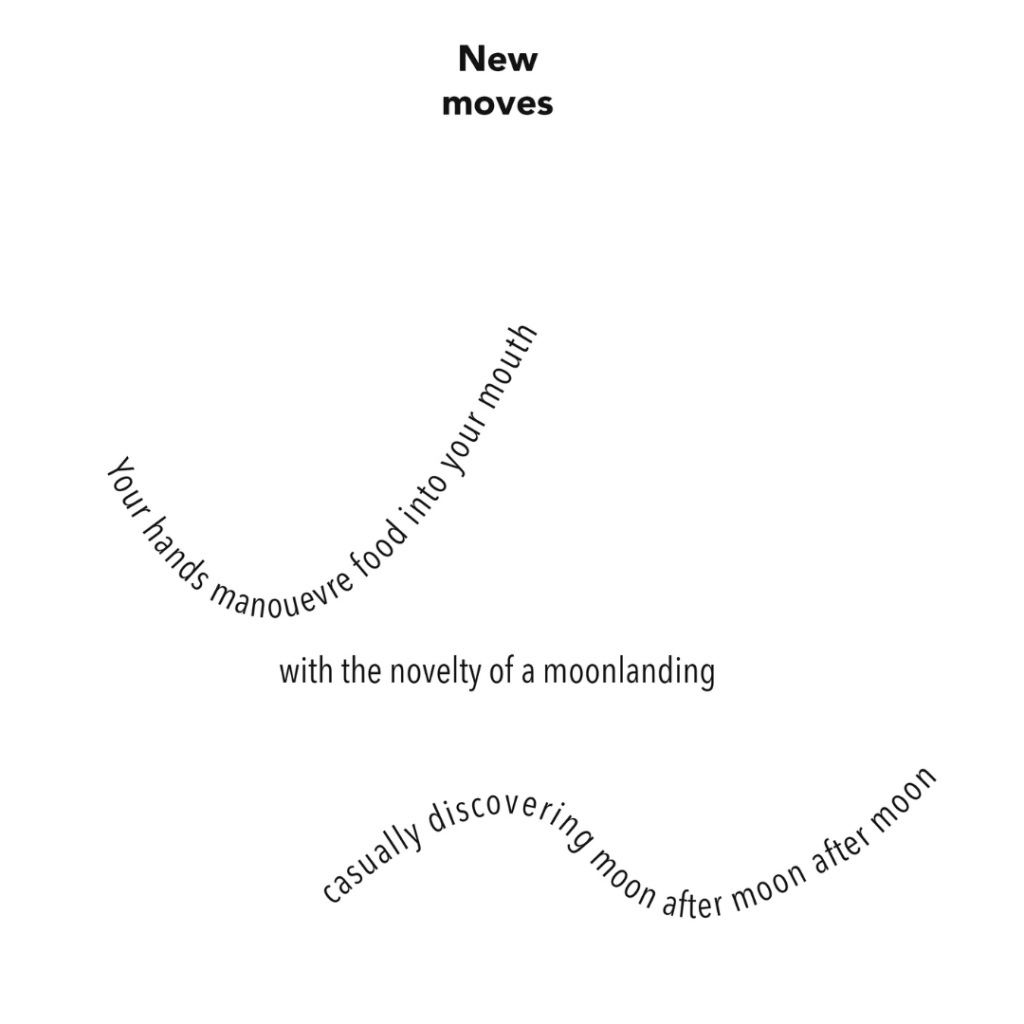
3. We loved the way that your drawings and poems interact on the page. Did you envisage these separately during the creative process?
Yes. They grew separately, parallel. I wrote and painted and after a year or so I saw how it the poems and paintings could come together in a book. The form of the poems developed in relation to the painting, and a lot in conversation with my graphics editor Alexandra Huddleston at The Kyoudai Press, between 2023 and 2024 when the manuscript was reviewed. I took a lot of inspiration from picture books, where text and image interact more freely than in most publication types. And the original paintings are often shown individually, or in installations which, from afar, seem like a text of signs.
4. Could you please fill us in on your influences?
There was a Vietnamese influence as my father had lived in Vietnam, and there were calligraphy paintings in the house I grew up in. And two residencies in Vietnam led by Elise Luong and Undecided Productions shaped my work profoundly.
I lived and worked in Thailand for a year, and it was there that body language struck me as a universal language. A Buddhist monk once told me to “Put the mind in the body” and this stayed with me. I love to dance, and to watch dance, and worked with the dancer/weaver Miriam Rose Gronwald translating between dance and ink painting.
In terms of artwork: Lee Ufan’ s “Relatum” installations, as well as his “From Line, From Wind” works. The way poetry and painting come together in the work of Christian Dotrement. The space in Japanese woodblock prints by artists such as Hiroshige.
Poetry: The calm clear honesty of poet Maggy Smith. The joy of Mary Oliver. “Small Kindnesses” by Danusha Laméris. “If” by Norman MacCraig. Rainer Maria Rilke; how he makes German sing and “The Dinggedichte.”
5. Name one piece of art you’re reading/ watching/ enjoying at present?
The monk robot books by Becky Chambers. They’re incredible.
Interested in exploring more of Mimi’s work? Find more at https://mimikunz.com
Her Insta is @mimi.kunz
 Porridge