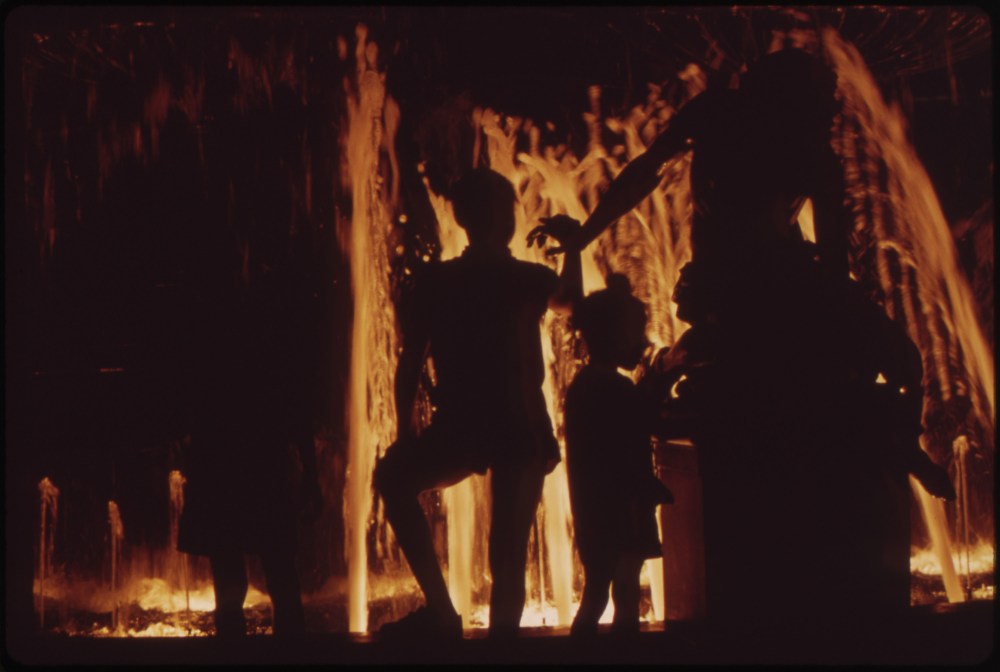
Source: US National Archives via Flickr Creative Commons
The Grammar of Forgetting
The city was forgetting its name. Elara knew this the way she knew most things now—by what was missing.
From her chair, she mapped the metropolis in its slow subtraction. The ivy on the building opposite had browned at the edges, its leaves curling inward. The old stone of the cathedral sweated a dark patch that never dried. She had been watching these details for three years, and she understood that watching had become her way of not doing anything else.
Her ex-husband, Leo, had called her work morbid. “You’re cataloguing ghosts,” he’d said, before he left for Auckland. He sent photographs of green hills and full reservoirs, digital postcards from a world that still conjugated the future tense. She never replied with images of her own. What would she send? The fountain that no longer ran? The school playground fenced off against the heat? She told herself the asymmetry was aesthetic. She suspected it was something else.
She wasn’t cataloguing ghosts. Ghosts were what remained after. She was documenting the moment of un-becoming—and if she was honest, she had begun to wonder whether the distinction mattered to anyone but her.
Her current project was the sound-map. The city’s audio palette was thinning, and she tracked each erasure with the devotion of a monk copying a dying language. In her filing system—dated folders labeled with coordinates and decibel readings—she had archived the specific clatter of the number 42 bus, gone now, its route cancelled due to repeated flooding. The morning chorus of starlings that used to mass in the plane trees, replaced by the low hum of air conditioning units fighting a losing war. The particular resonance of the church bells at Santa Maria, which used to mark the hours with bronze certainty, now irregular, dependent on the grid’s unpredictable mercy.
She had recordings of children’s voices from the primary school playground, before the heat advisories made outdoor play a relic. She had the sound of rain on cobblestones—a file she hadn’t opened in eight months.
She told herself this was rigor. An archivist does not wallow in the archive. But she knew the real reason: the rain file was not a record. It was a room she had lived in once, and entering it now would only confirm that she no longer could.
Today, a new silence. The piazza fountain below had been turned off. For fifty years, it had been the district’s heartbeat, a steady, splashing phrase the neighborhood had stopped hearing because it had always been there. Now, the basin was a dry bowl, littered with the papery husks of leaves. The water authority’s notice, taped to its rim, flapped in the hot wind.
She zoomed her camera, focusing on the bronze statue at the center—a woman pouring an eternal, now-absent stream from an urn. A fine yellow dust, carried from the northern deserts that were once farmland, coated the statue’s shoulders. Elara had photographed this fountain every month for three years. Forty-seven images in sequence, a flip-book of subtraction. In the earliest, water arced from the urn in a clean parabola. By month eighteen, a trickle. By month thirty-two, Sundays only. Now, this.
She framed the shot carefully, adjusting for the light. Forty-eight.
It occurred to her, not for the first time, that she had more photographs of this fountain than she had of Leo.
She had read Calvino in graduate school, when the future was still a place you could plan to visit. She remembered underlining a passage about how cities, like dreams, are made of desires and fears. She had thought it was beautiful. Now she understood it was a warning. Desire could drain a reservoir. Fear could empty a playground. And someone like her would be left to label the files.
Her phone buzzed. A notification from the global monitoring service Leo had signed her up for before he left—a parting gift wrapped in guilt. Extreme Heat Event: Day 14. Hydrate. Minimize exertion. She looked at the bottle of tepid water on her desk. She had stopped counting the days when the count stopped mattering.
Leo would ask, if he still asked, why she didn’t leave. She had prepared answers: the work, the record, the responsibility of witness. But lately a different answer had begun to surface, one she hadn’t yet said aloud. She stayed because leaving would require believing there was something ahead worth arriving at. The archive asked nothing of her but attention. It made no demands on her hope.
This was the thing she could not put in a folder. The suspicion that her vigil was not devotion but its opposite. That she had become so careful a student of endings that she had forgotten how to begin anything at all.
A memory surfaced. Leo, three years ago, in their bedroom on a winter morning that felt like another century. Pale light through the curtains. He lay beside her, looking up, and pointed to the fine crack running through the plaster above them. “It has character,” he’d said, pulling her close.
She had laughed. She saw it now for what it was. Not character. A fissure she had chosen to find charming because the alternative was to do something about it. By spring, the crack had branched. By summer, it had opened. By autumn, Leo had accepted the job in Auckland, and she had understood, without words, that he would not ask her to come.
She had told herself he was the one who left. But she had made it easy for him. She had been practicing departure for years, withdrawing into the work, the files, the long hours at the window. He had simply done out loud what she had been doing in silence.
She returned to her screen, to the image of the dry fountain. She adjusted the contrast until the dust on the statue’s shoulders sharpened into relief. She was not preserving the city that was. She was building its tombstone, and the work was so absorbing that she did not have to notice she was building her own.
The city was forgetting its name. She knew what came next. Not dramatically—no evacuation order, no exodus. Just a slow hemorrhaging of the young, the mobile, the ones with options. The grid would fail more than it functioned. The last trains would stop. Those who remained would be the ones who had nowhere else, until even they scattered or succumbed.
She had no plan to leave. She did not know, anymore, whether this was integrity or its counterfeit. To leave was to stop looking. But to stay was to keep looking at the same thing, the same absence, until looking became indistinguishable from hiding.
Outside, the light took on the thick amber quality of late afternoon. She did not feel despair. She felt a strange, cold clarity—the kind that comes when you have finally stopped arguing with yourself.
J.M.C. Kane is the author of Quiet Brilliance: What Employers Miss About Neurodivergent Talent and How to See It (CollectiveInk U.K.), a celebrated nonfiction work on cognitive patterning and inclusion in the workplace. Disabled, he writes from this learned experience as an ASD-1. His prose work has been published in more than two dozen literary journals & magazines. Kane admires compression the way some people admire tightrope walkers: from a safe distance, practicing only at home. He lives in New Orleans with his dogs and family.
 Porridge