
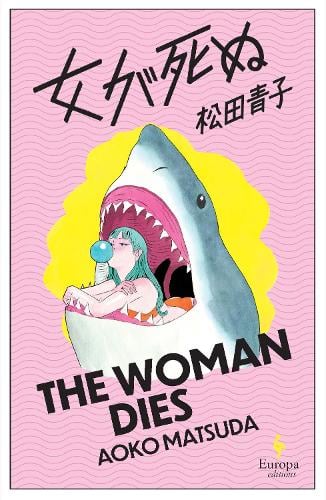
A hearty mishmash of short stories, flash fiction, and vignettes, The Woman Dies delivers incisive social commentary with a blend of humour and surrealism.
Aoko Matsuda’s previous English PEN award-winning release Where the Wild Ladies Are (Tilted Axis Press, 2020) retold Japanese ghost stories from a feminist perspective. Reuniting with translator Polly Barton, Matsuda revisits similar themes in this new collection; across fifty-two stories, she tackles the pervasive misogyny faced by women in contemporary Japan and beyond.
In ‘Bond’, former Bond girls gather to initiate newbies into their glamorous world and play bingo, while ‘We Can’t Do it’ is a defiant parody of the overplayed Rosie the Riveter slogan. Other stories dissect the sexual double-standards women are held to, the way even make-up products are prescriptively named, and sexism in the workplace. By defamiliarising the everyday, sometimes to the point of the absurd, Matsuda forces us to revisit what we consider part and parcel of being a woman in the world.
The title story – a critique of how violence against women is used as a plot device, originally published in Granta and shortlisted for a Shirley Jackson Award – has received much praise. However, ‘The Masculine Touch’ is similarly, if not more, brilliant. Lampooning the idea of a ‘feminine perspective’, this story focuses on an unnamed male writer renowned for his ‘unique masculine touch’. After rising to fame by launching a revolutionary male product so influential that his work heralds ‘a multitude of changes in Japanese society’ (if this seems bombastic, that’s the point), he is invited to a discussion with a male author on the theme of masculinity.
Beginning as a conversation about the barriers to men’s social participation, things spiral as the two men share their experiences of sexual harassment, objectification, and resulting body image issues. They recount the comments made about their genitals, “He’s got cheek acting so tough when he’s that small”. These insults seem familiar because they are typically directed at women and their bodies – penis measurements even directly correspond to bra sizes (“His dick is like a D”) – often as punishment for rejecting men’s sexual advances. But for Matsuda it is not enough to simply reverse the roles of the sexes, she intends to fully accentuate the absurdities of sexism.
Therefore, at the story’s climax the male writer and the male author strip off and perform ‘a splendid rendition of the Grand Pas de Deux’ where they dance so vigorously, and so passionately that ‘[t]he male author’s masculine touch and the male writer’s masculine touch came together, converged and fused, creating great undulations in the air.’ It’s hilarious – one of the few times I have genuinely laughed out loud at a book, on the tube no less – and a really great example of how Matsuda experiments with surrealist elements to truly subvert our expectations. What begins as a story exposing the superficiality of corporations’ and governments’ commitment to women’s empowerment escalates into a farce, emphasising the ridiculousness of this tokenistic and reductionist approach. To echo the thoughts of both the male writer and the male author, ‘[i]t’s all so fucking stupid’.
Hysterical escalation of events and twisting and turning narratives are part of Matsuda’s stylistic playfulness and are often used to create stories which surprise and captivate, providing a fresh perspective on a wide array of subjects from works of classical art to the Japanese national anthem. However, as is to be expected with a collection of this size, there are occasions where this experimental style and desire to defy readers’ expectations falls flat. I am thinking in particular of ‘Baseball Player Soup’ which has one of those awful hammy twist endings, and of ‘The Year of No Wild Flowers’ where the metaphors felt quite laboured – though I can see how others may consider it an interesting exercise in ecofeminist critique.
Thankfully, these stories are in the minority. Overall, this collection is very strong and there is plenty to excite and stupefy readers in equal measure.
Arbnora Selmani is a Kosovar-British writer from London. She is the founder of Porridge magazine’s Comfort Foods section and a regular contributor to the magazine. Her work has also appeared in Asymptote, Tate etc, and Dear Damsels. Her debut pamphlet ‘Portraits’ was published in 2018. She lives in NW London with her husband and son.
 Porridge