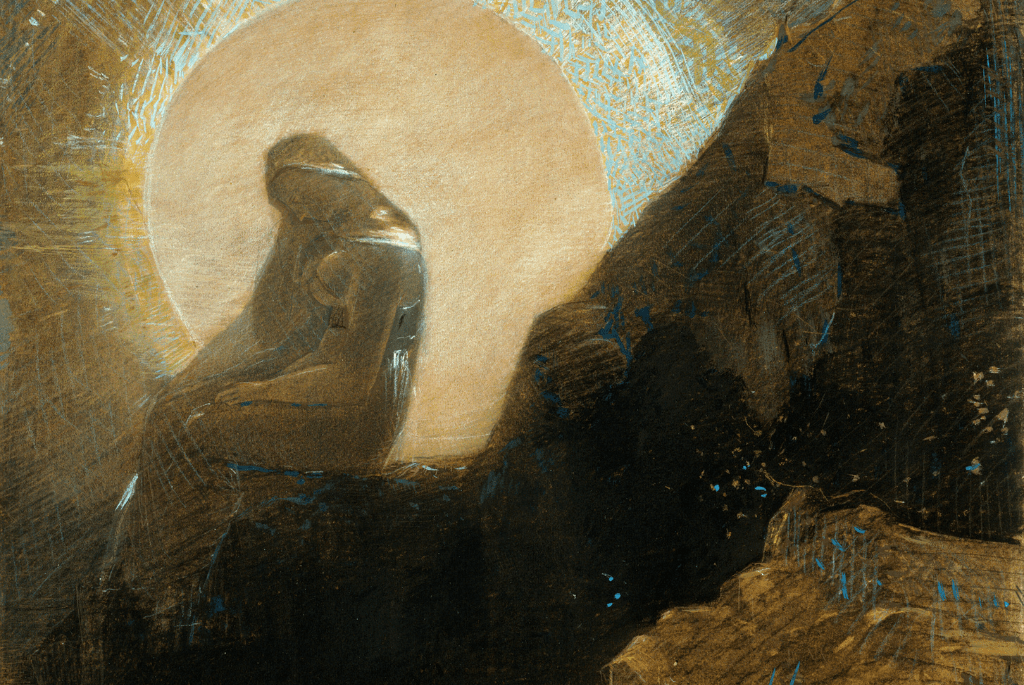
The Light Of The World
When God made the world he contracted his divine self to make way for his creation. He stored his divine light in special vessels called kelim. Some of these kelim shattered and the scattered light attached itself to the broken shards. These became the basis of the material world and all the evil in it. Adam, the first man, was supposed to restore the divine light, but sin got in the way and human souls are imprisoned until what is holy is restored and returned from the created world back to God. Repairing the world – the meaning of Tikkun Olam .
Rabbi Golding would be visiting tomorrow, as he did most Thursdays. No one else visits Alice now. For a start there isn’t a lot of room for visitors, and the house smells of cats – she’s lost count of how many. The rabbi is the only person she can bear to talk with these days. Not that she’s religious. She is a scientist. The rabbi said he was a scientist too, so what? The rabbi likes to interfere, knows a good woman who can come in and clean. But Alice doesn’t want a stranger in her house, rearranging her precious things and her papers.
These things and papers are her life now. Her collection of walking sticks, her grandmother’s old samovar, a model of an ancient astrolabe, statues of cats and Egyptian goddesses; she much prefers things, and animals, to human beings any day.
She can hear the whining of a cat outside, and peeks out of the window at the overgrown garden, settling into dusk. The sky is cold and clear. There might even be stars, she thinks. Her greatest love from childhood until now had always been the night sky. Her father bought her her first telescope when she was 7 years old, in 1936. Not a bad one either. Every birthday she asked for star charts and books about the planets. But the war put paid to her ambitions. Her education in the Orthodox Jewish school didn’t amount to much, and she left before she was fifteen to help in her father’s small business.
Her father had carried on the family business from his father, who was a master cabinet maker, specialising in bureau bookcases. Alice remembered her grandfather working in the cellar of their home, one of a terrace of decaying Edwardian houses in north Manchester. It was a two up two down with an outside lavatory. There was a wash-house with a copper and a mangle, and a stone-flagged yard. A shed at the far end of the yard was where Grandpa stored his wood and where Grandma kept half a dozen chickens.
Alice would spend hours in the basement workshop, helping to sweep up the sawdust, breathing in the smells of glue and wood-stain. Grandma sat in the parlour upstairs, in a black dress and shawl, smelling of wintergreen ointment lavishly rubbed in to relieve her rheumatic pains. She liked to sit at a table covered in a deep red chenille cloth fringed with little bobbles, reading her Yiddish books by the light of the gas mantles. The light they gave out was yellowish and they made a hissing noise.
Alice’s mother died when she was only five, and grandpa died not long after, so there was only her father and her grandma to take care of her. Her father helped her set up the telescope in the back bedroom and together they would watch long into the night. At school she was considered an odd child, wandering off, staring at the sky and talking about her cat like it was her sister. The children said she was a witch and her cat was her familiar. Alice Nutter they called her, one of the Pendle witches their teacher had told them about. She never had a birthday party, nor was she invited to anyone else’s.
A gust of wind rattles the windows. For a moment, Alice thinks she can smell something earthy and sweet in the air, like gorse flowers or hillside heather. Before the war her father, a keen walker and cyclist, used to take her by train on Sundays for walks on Kinder Scout, Bleaklow or Hardcastle Crags. When she was only three he had spent a week in prison for punching a game-keeper during the Kinder Scout trespass. Her mother had raged at his irresponsibility, leaving her to cope with a small child all on her own, and such a difficult one too.
When he could take a few days off they would go to the Lake District and camp wild. Their favourite was Boredale, beneath the great hulk of High Street, where red deer roamed over the Nab. There was one old wooden chalet on the hillside, and Alice recalled a memorable day when they had awoken to the sound of bagpipes coming from it, and the great herds of deer scampering hither and thither in fear.
Alice has scores of scrapbooks and albums of photos and drawings, and the journals she had written at the time. Even after she was married, had a child and – against the wishes of her husband Samuel, a traditionalist at odds with the changing times – returned to work with a new job in Social Services, she never lost her love of walking the hills. Once her son Arthur was at university and her wages were decent, she could go further afield. She was in her fifties then, and still fit as a flea, when she booked onto a guided hike in the Apennines in northern Tuscany. This was the holiday that changed her life. She watched the snakes that scuttled away into the undergrowth, and held her breath when she came across herds of wild boar on the hills, and at night fireflies delighted her as they darted along the edge of the tracks leading back to the hotel.
But the most thrilling aspect of the holiday was the presence of Jocelyn Bell Burnell; she who had discovered pulsars. Jocelyn, a PhD student at the time, did the work – her professor was awarded the Nobel Prize. Alice had never met a real astronomer before, and she prevailed upon Jocelyn, if she wouldn’t mind, to give her a guided tour of the skies, which here in Tuscany were so clear and unpolluted by artificial light that large swathes of the Milky Way were visible, along with the constellations of Cygnus and Lyra, and the Big Dipper and Cassiopeia. Alice could hardly breathe. She filled many scrapbooks with pictures and jottings from that holiday. Jocelyn asked why she didn’t apply to study Astronomy with the Open University – encouraged her to do it the minute she arrived home. And she did. At 60 she was awarded her degree.
Yes, this is her life, she would often say to Rabbi Golding. To others it may be a mess in need of tidying, but to her it is everything she has lived and does not want to lose. They said it was dangerous. What if there was a fire? Neighbours complained. And it was unhealthy, all those cats. Their children could catch diseases from those cats, shitting everywhere. The women in the synagogue tried not to sit near her. Soon she stopped going to synagogue, anyway.
After she retired she devoted herself to her astronomical studies. She still had a telescope in her attic. She had been fascinated by the discovery of the asteroid Apophis in 2004. It was named for the Egyptian god of chaos, the opponent of light, who appeared in art as a giant serpent. That an asteroid might threaten now, as it did the dinosaurs billions of years ago, thrilled and obsessed her. She talked to the rabbi about her thoughts. Perhaps science and religion were not that far apart, she said. The asteroid could hit the earth, returning its light to God, bringing darkness back to creation. And besides, the big bang – expanding the universe to take God’s space –will one day reverse and the universe collapse once again to the singularity, to oneness, to God? – wasn’t that Tikkun Olam?
But Rabbi Golding is one of those modern reform rabbis, not like the ones who taught her as a child. He interprets Tikkun Olam, he says, as signifying the healing of the world through the pursuit of social justice. Alice cares little for this modern preoccupation with social justice. Anthropocentric, she thinks. What were humans to her? Insignificant creatures, puffed up with their own self-importance, harmful beyond their meaning or their right to exist. She prefers her cats – and the stars. But she enjoys arguing with the rabbi. She is glad she had been born into a religion that encourages arguing, even with God.
But despite her disdain for her fellow man Alice always presses on the rabbi large amounts of money for his favourite Jewish charities. She doesn’t need money. She hardly eats anything except breakfast cereal and bananas, plus she has her subscriptions to astronomy magazines, and food for the cats to buy. The telephone had long ago been cut off. She likes the house cold. She never cooks. Hardly washes or cleans. And she certainly isn’t going to let her son inherit any of her money. He doesn’t visit any more.
He used to come. He would tidy the garden sometimes. He built her a pond, and frogs came. The cats would catch them – not to kill or eat them – just to play and torment them until the frogs screamed. Alice and Arthur argued about it. It’s nature, she said. Red in tooth and claw. Soon he stopped coming at all. He said he couldn’t bring her grandchildren to this death trap of a house.
So what does she need with sons, grandchildren, the endless self-serving pettiness of human life and reproduction, and all the illusions about progress and human inventiveness? How she longs for the asteroid to come, to show them how little they controlled anything. Or perhaps a virus. Humans could be humbled and defeated by the infinitely large or the infinitely small. Whatever it is, she is ready.
But tomorrow Rabbi Golding would be here, harassing her about her 90th birthday and the party her son and some of the synagogue were organising. What rubbish.
*
As night falls Alice eases her way through the living room. The cats have brought in a bird which must have been there for some time, as maggots are crawling from it. A jumble of mugs and bowls are waiting to be carried through to the kitchen. Fruit flies hover around them. She’ll sort it out tomorrow. Now she wants to get upstairs to the attic, which she does by hauling herself up on hands and knees.
Venus is high in the western sky, and so, so bright – Venus, the Goddess of love – but for all the wittering about love in the world, did anyone even spare her a glance? And Juno was there, sitting below Delta Virginis, brighter and larger than she had ever seen it. Could this be the asteroid that would come for her? She spends hours watching, adjusting her telescope, studying, making notes and rough charts. It gets very late. She is too tired to go back downstairs to the bedroom. She unfolds some damp and slightly mouldy blankets and spreads them out on the floor. She lies down, positioning herself so she can still see Venus through the skylight. And so she sleeps, the light of love shining down on her.
*
In the morning Rabbi Golding arrives. He rings the bell but there is no answer. He peers through the letter box, which is stuffed full of junk mail. He goes around the back, negotiating the weeds and the sycamore saplings growing along the path. Through the kitchen window he sees only cats licking at a pile of unwashed cereal bowls. He tries the back door which opens easily. He shouts. “Alice!” He sidles through the house, up the stairs, shouting all the while. He pushes open the door of the attic, knocking over a stack of books and files as he does so. The morning light is streaming through the skylight.
It takes Alice’s son and a handful of congregants from the synagogue several months to clear and fumigate the house; rehome the cats, at least the more presentable and healthy ones; sift through the papers, charts and albums. Rabbi Golding conducts a small funeral. Arthur reads a few lines from her favourite Robert Frost poem:
“Lord, I have loved your sky,
Be it said against or for me,
Have loved it clear and high,
Or low and stormy”
The rabbi says a few words. What can he say? The usual platitudes? She loved life? She will be missed by those who loved her? She gave tirelessly of herself? The rabbi is silent for a minute or so. “Alice Roth sought the truth and the light,” he says, “and she found it in the darkness of the night sky”.
Sue Beardon is 78 years old, retired and with a career including community arts, voluntary sector management and mountain leadership. As well as writing Sue loves singing, which she does in bands and choirs, and still loves to walk in the hills. Sue was born into a Jewish family that came to England around 1900 from Eastern Europe. Now she is a member of the Religious Society of Friends (Quakers).
 Porridge