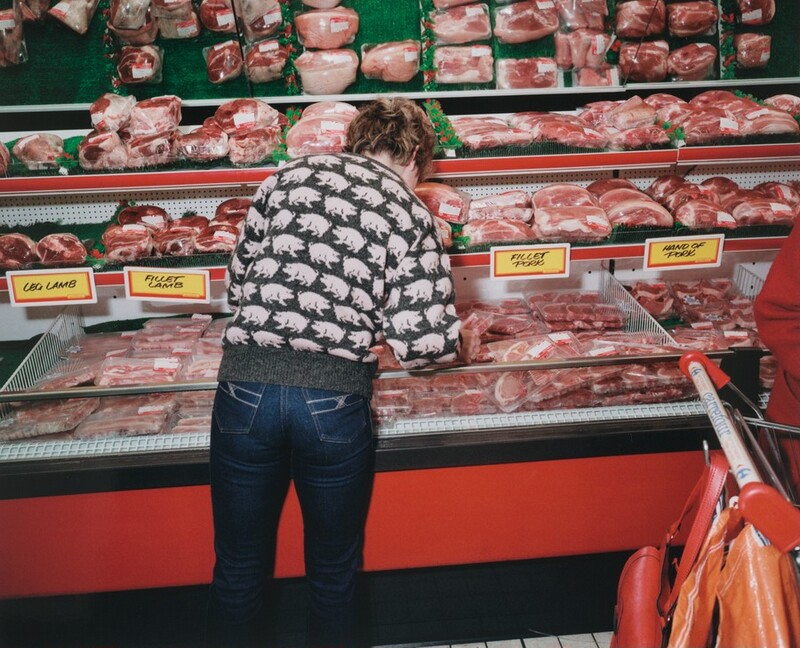
Paul Reas, National Gallery of Art, Washington
Ends and Pieces
Bacon.
B-A-C-O-N
Just typing the word makes my mouth water. Prompts a deep inhale. My nose searching for the delicious aroma of it frying in a cast iron skillet. Eyes closed to better imagine the sizzle and pop of it quivering in the hot pan. Silently wincing at the thought of hot grease jumping from the pan to sting my bare forearm. I imagine strips of it next to creamy scrambled eggs. Or piles of it on soft white bread with mayonnaise, lettuce, and tomatoes. Bacon is truly one of life’s great pleasures. Growing up, the only time we ever saw bacon in strips was in television commercials. Mom, on her own with three kids, could only afford Ends and Pieces.
Ends and Pieces are exactly what they sound like. The ends and pieces left over after bacon is trimmed into the evenly sliced strips you see in the grocery store. The scraps and bits that don’t make the cut. You’ve probably never noticed them. Their red and white box usually sits well below their thick-cut, smoked, and maple-flavored cousins in their clear ‘look at me!’ packaging. Or, sometimes, Ends and Pieces aren’t displayed at all, and you have to ask the butcher for them. Because, mind you, they are the ends and pieces, the leftovers, the scraps. Who would want them?
My mom, that’s who.
Mom grew up in Pennsylvania, close enough to the West Virginia border that she considered herself a southern cook. And like any good southern cook, she used bacon grease for everything. She sauteed in it, fried in it, flavored with it. She kept a supply of it on the stove in a short, stout aluminum tub with a shiny black lid and an ever-present sheen of greasy fingerprints. Any and all bacon grease ended up poured into that tub. Bacon grease is naturally bacteria-resistant, so the tub never went in the refrigerator. It just sat there on the stove, being used and added to throughout my childhood.
Since mom’s priority was the grease, buying Ends and Pieces made both practical and financial sense. We often lived on bread, eggs, and milk and bacon grease helped make everything taste better. The added hint of ‘meat’ made everything from scrambled eggs to canned green beans taste and feel more substantial. No one was talking about cholesterol in those days. We didn’t know then that mom’s arteries were clogging up.
We longed for ‘real’ bacon, the strips we saw frying on TV, but understood that they were out of our reach; so we never complained. Complaining made mom feel bad. You could see the pain on her face when we ached for something she couldn’t afford, when she had to say no. So when we helped her unload the groceries at the first of the month, and pulled out that red and white box, we rolled our eyes at each other but never let her see. We learned to make do with what we had.
And while we silently hated that red and white box, the way it reminded us we were poor and made us feel embarrassed when our friends spent the night, it did have its moments. There was nothing better than digging through the box, past the chunks of white, slimy fat and the occasional reedy strip of pink meat to find a surprise nugget. A literal hunk of bacon. Every box usually held at least one. If you got lucky, your box might have more than one. If you got even luckier, the hunk might be big enough to share, to slice. These were the best days.
My little brother was obsessed with cooking shows and every day after school he watched Julia Child work magic in her studio kitchen. He was a good study and learned to work wonders with the bread, eggs, and milk that were the staples of our childhood. He also used the cheese we got in the Government food boxes mom picked up at the church down the street. If he had a hunk, a nugget of bacon to work with, he could create a masterpiece. A fluffy omelet, a crispy frittata, or a cheesy egg sandwich. If we’d scored the white cheese that month, it was a bonus; it melted so much better than the yellow. I loved to watch him in the kitchen, moving fast like a seasoned short-order cook. Magically turning our spare commodities into something special.
Mom performed the same type of magic all the time. Spending hours in second-hand stores hunting for girl scout uniforms, soccer shoes, sheets and towels. She got up early on Saturday mornings to hit yard and garage sales, looking for inexpensive furniture and art pieces to turn our cheap, dilapidated rentals into a cozy home. Extolling the virtue of reuse and recycle long before it was en vogue, she instilled in us the idea of one man’s trash is another man’s treasure and made every outing a treasure hunt.
Despite moving up in the world and having more disposable income than my mother might ever have imagined, I still enjoy strolling flea markets, second-hand stores, yard and estate sales, and relish in the pleasure of finding treasures hidden among someone else’s discarded items. My home, like my mother’s, is a mash-up of old and new. Paintings purchased at galleries hang next to others found at Goodwill. My custom sofa is flanked by estate sale chairs. I’ve even found a few actual treasures: Jack Black pottery for $3.00 at Goodwill, a museum quality Nancy Bush painting for $10.00 at a second-hand store.
Every time I find something worthwhile while digging through the piles of discarded and donated items I think of my mother and the lessons she taught us with Ends and Pieces.
How to work with the scraps, do the best with what you have, and always look for the nugget.
Lisa Ochoa is an emerging Chicana writer living and creating in her hometown, Tucson, AZ. Lisa’s work explores the complicated world of intimate relationships and the things we do to survive them. Recently, poems and other works have been curated by In Parentheses, Moonstone Arts, Beyond Queer Words, Musepaper, and Bridge Eight Press. When not writing, Lisa can be found curled up with a good book, crawling her favorite thrift stores, or in the kitchen testing TikTok recipes. Read more at www.lisaochoa.com
 Porridge