Trying To See
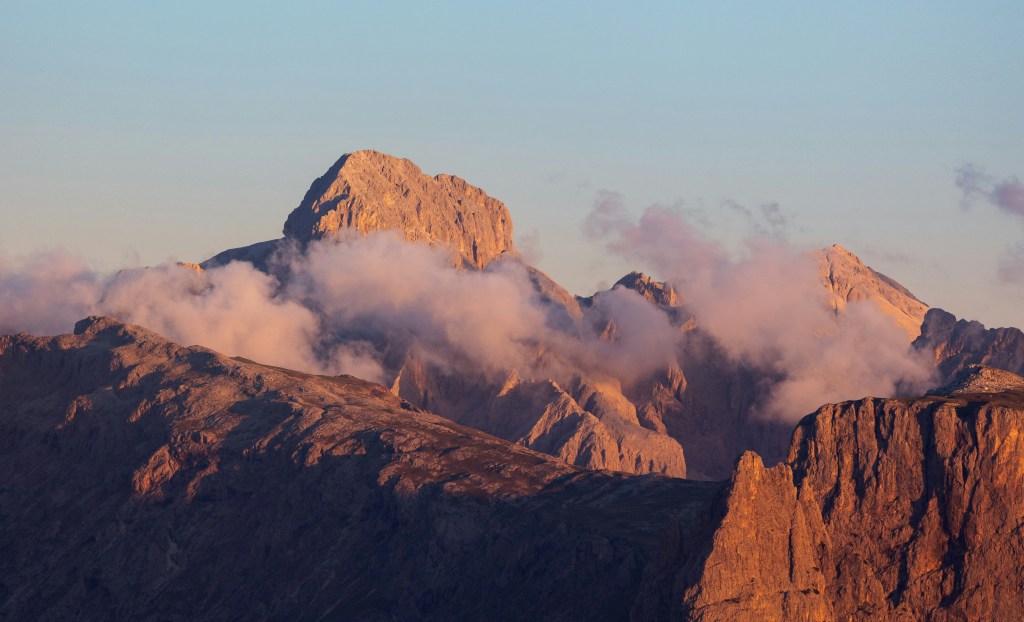
On a sunny September day in the early 1990s, a German couple taking a shortcut through the rock spires on the Austrian-Italian border spotted the head and back of a man jutting from a patch of half-melted ice. The couple, thinking they’d stumbled across the corpse of a mountaineer, told the owner of the inn they were staying at. He, in turn, contacted the authorities, who sent a forensic investigator.
As more of the body appeared, people kept revising their guesses as to its age. Maybe he was that teacher who’d gotten lost here during the 1940s. No, he could have been a soldier from World War One, which raged across these mountaintops, littering them with guns and shells and corpses that still periodically reappear.
But the clothing fragments they found weren’t the synthetics of a modern hiker or the boiled wool coat of a soldier, but furs and a reed cape. There were arrows with him, an unstrung longbow, the wooden bracing of a pack. Maybe he was from the Middle Ages, someone speculated. Trade routes had run through these passes for centuries.
A couple of men casually hoisted the body onto a stretcher and loaded it onto a helicopter, which flew it to Austria for investigation. One of the men didn’t even wear gloves.
The archaeologist in Innsbruck was the first to suggest the mummy might belong to prehistory. In an interview, he recalled that people smiled patronizingly when he said that it might be three thousand years old.
In fact, it’s over five thousand years old. Ötzi, as he was dubbed, ran across these fields of dirt and scree when copper was the hardest metal people had learned to work. Now, you can view him through a small window in an archeological museum in the northern Italian town of Bolzano/Bolzen. He’s cocooned in a tiny cold room, sprayed with water and refrigerated to replicate his glacial entombment.
My family and I went to see him a few months ago. I’d heard about him for years, even come close once to the Austrian side of the ridge he was found on. I’d read about his desperate trek across the mountains, running from the men who killed him. I read about what he’d eaten and what he carried with him. Dreamed about what it would be like to be hiking one day and stumble across an ancient crime scene, to stand in a puddle of softening slush and look into the face of a man who lived before the pyramids were built.
So when a trip took us to the Dolomites, I made sure we went to see him.
The past layers itself tightly as leaves of a book everywhere, but some places show it more than others. We flew from Vermont to Vienna to Venice, where we rode a taxiboat through the Grand Canal, encrusted with Renaissance palaces, to the airport on the mainland. There, we rented a gleaming white SUV to drive back north. Ski trams laced the mountains, following routes blazed by soldiers in 1915 to send war machines up the highest peaks. Just past the modern tourist chalets and ski trails, Roman inscriptions mark 2,000-year-old administrative boundaries.
Here, at the fringe of overlapping empires, place names are listed twice, in Italian and German. Restaurants offer tagliatelle and spatzle, gnocci and knödel. Everywhere in Bolzano we saw Austrian storefronts with dangling pictorial signs, capped by Italian-style red tile roofs. It’s a place of doubled vision, a basin surrounded by peaks. We drove there through gathering darkness, as the snow fell so fiercely behind us that roads closed and avalanches buried hillsides. In Bolzano, we woke to flowers blooming under palm trees.
The museum occupies a neo-Baroque structure built by the Austro-Hungarian Bank just before the first World War, and appropriated by the central bank of Italy when the region was conquered. The ground floor describes Ötzi’s discovery in detail. The top floor is for special exhibitions, devoted when we were there to the history of various foods, with flat-screen terminals inviting visitors to guess when and where rye was first cultivated, or the genesis of apricots.
The middle holds the body, and the constellation of things found under and beside him.
Despite all the articles I’d read and the displays downstairs with their interviews and colored maps, in the end, I didn’t care much for the mummy in his sheen of ice. He was too lifelike for comfort, with his skin and jutting bones, but too gaunt and desiccated to let you see who he had been. His eyes had shrunk into their sockets; half his nose was missing, and his upper lip twisted in what looked like a snarl.
I found his artifacts more poignant. He carried embers of his last fire, carefully wrapped in maple leaves and tucked into a birchbark pail, as well as a tinder fungus, in case the embers died. A short blade like a penknife hung from his belt. His coat, sewn panels of fur that alternated light and dark, recalled fashions I’d seen the week before in Venice.
He’d been running from his enemies; that much seems clear. Pollen and mosses in his gut show he started his journey on the valley floor, thousands of feet below. Someone came at him there with a knife, which he grabbed, cutting his hand. He bound the wound with antiseptic moss, snatched a copper ax, a reed cape, and other gear, and started climbing. He stuck to a gorge, a harder route to the heights but one that would have provided cover from attackers.
He had a staff made of yew wood, which he was turning into a long bow. If he’d finished it, he could have used it to take down a target over 160 feet away. But he hadn’t strung it—perhaps, with the cut in his hand, he couldn’t string it—meaning he had no distance weapons.
They shot him from behind, near the top of the ridge, over 10,000 feet above sea level. He bled out in minutes.
The attackers left his things, including the copper ax, which must have been valuable. They weren’t there to rob him; just to kill him.
Murder mysteries are gripping, no matter how old. Ötzi feels real in his final moments because this is something we can recognize: the fight, the flight, the chase.
But it’s a quieter kind of threat that humanizes him to me. Just a couple years younger than me, Ötzi wasn’t in great health even before his enemies stalked him across the high country. He had Lyme Disease and intestinal parasites, and ate toxic bracken fern, maybe to kill them off. His joints were worn and probably painful. All over his body, short lines were tattooed over zones we use for acupuncture.
A bearskin cap, nearly perfectly preserved, lay beside him, carefully stitched through the crown. The animal whose skin this was had lumbered through mountains still wild, free of engines and fences and artificial lights. To kill one with a wooden spear must have been a chancy thing, the cap a badge of courage or skill.
That bear’s world is gone, though the mountains remain, jagged fins of rock through which people have hunted, traded, fought and worked side by side for centuries. Standing there, you’re drawn into a spectral proximity to everyone who has gone before: soldiers and Roman legionnaires, medieval tradesmen, pilgrims and nomads and prehistoric men.
All of them are layered into the history of this place. Those who fought over these rocks, like the teenagers in sodden uniforms—Austrian, Italian—that still melt out of the ice. Those like Ötzi who were chased there. And I, a tourist and a foreigner, who paused here for a moment and tried to see.
Erin Ruble’s essays and short fiction have appeared in Fourth Genre, Boulevard, River Teeth, and elsewhere. You can find her at erinruble.wordpress.com.
 Porridge