Little Doorways
Food was my grandmother’s love language. She was from Malaysia, where good food is priority number one. Achi—the Sinhalese word for grandmother and what we called her—met my Welsh grandad during the Malayan Emergency in the 1950s, where he was serving in the British police force. They got married and settled down in Cardiff, before he died relatively young. Achi stayed in Wales to be near her children and forged a full life for herself.
She worked as an auxiliary nurse at Cardiff’s main hospital, a job she loved, and made deep friendships which endured for the rest of her life. She also had a huge hand in raising us six grandchildren. Even though she could be formidable, and at times, slightly terrifying, her love was unquestionable. And her food was the ultimate conduit of that love. It showed up in gestures so subtle, they were inevitably overlooked. I see things differently now though. I understand the way she used to decimate the pink flesh of salmon fillets with a fork, not as some perplexing preference of hers, but as an act of care to protect me from swallowing fish bones. And I see those plain pastry cakes I used to get at family dinners when everyone else got apple pie, as her remembering I hated the tartness of cooked apple.
When you’re a first, second, third generation immigrant, and so on, food takes on new dimensions. It can be a balm for homesickness and an entry point into identities that can sometimes feel inaccessible. For me, it was the common language of our family. Although we were all varying degrees of white and brown, fully Malaysian, or just a bit—our deep yearning for Malaysian food signified we all belonged to the same group.
I always took my Malaysian identity for granted. I didn’t feel the need to celebrate or connect with it because it felt so ingrained in me through Achi—my personal touchstone for my Malaysianness—and growing up, I saw her and the family all the time. Eating with my Malaysian family felt like one huge open doorway to that side of myself, and I happily straddled my Welsh and Malaysian cultures, obliviously enjoying the benefits of both.
One indisputable benefit was Achi’s cooking. She was a natural-born chef and loved cooking British and southeast Asian cuisine, quite often blending the two. A perfect example of this was her inclusion of beansprouts in a Sunday dinner. They’re not a typical British roast dinner vegetable, never mind how good they taste doused in gravy. For big family gatherings, British food bowed out to Malaysian—in my opinion, the far superior cuisine. Everyone would descend on Achi’s house in Cardiff, the family’s Wales-based HQ, and the pre-dinner pomp would commence. The circular dining table would be pulled into its extended oval shape and ceremoniously veiled with a white well-ironed tablecloth, just like a bride on her wedding day. A never-ending supply of chairs would appear as if from nowhere for all the strangers who appeared periodically, usually turning out to be my second or third cousins. My job in all this, as the youngest grandchild, was putting out the “good” knives and forks; my dad scurrying behind me switching them over as I placed them the wrong way around.
When a precarious tower of poppadoms made their way to the table, it signalled dinner was imminent and an excited hush would fall over the room. We’d flock en masse towards our seats, then the main event would begin. First came mountains of rice-cooker rice, always two or three times the recommended portion size per person. Next was Malaysian chicken curry, or kari ayam. The dark yellow sauce, with red oil sat on top, concealed hunks of chicken thigh and potatoes swimming beneath the steaming surface. There were usually some token vegetables bringing up the rear, like curry cabbage, runner beans with chillies, or beansprouts, in their rightful place, alongside their other Asian food relatives. And there was unfailingly, a side of sambal belacan. This dangerously spicy condiment sparked the family competition over who could handle the most heat. It was a given, the whiter you were, the less sambal you ate. To our amusement, a theory my husband failed to disprove.
Those raucous family dinners hold court in my memory. I see us all squashed elbow to elbow around the dining table, the windows steamed up, and the initially pristine tablecloth stained yellow with curry and bits of crusted rice. Achi, our unshakeable matriarch, spoons second and third helpings of food onto plates, her tinkling laugh cutting through the cacophony of overlapping voices.
When she died in 2024, the family became untethered from one another, although the distance had already been growing for some years. She was the nucleus around which we orbited, and she was gone. So our family bonds were severed with a painful finality. I knew we’d all be heartbroken when she died, but I hadn’t predicted the sense of identity loss I’d feel when there was no Achi, no Malaysian family, and no sharing of food like that in my life anymore. The grief felt amplified. I developed a deep anxiety I’d lost access to a part of myself, one I hadn’t even appreciated at the time, and it was never coming back.
Around then, Malaysian food changed from an occasional pastime into my obsession. Cooking and eating the dishes of my childhood became a ritualistic way of remembering Achi and feeling connected to my Malaysian heritage, which to me, were still one and the same. I couldn’t separate Achi from my feelings of connection to my Malaysianness and conversely, the loss of her from my disconnection to it.
It was an internal struggle captured in the memoir, Crying in H Mart, by Michelle Zauner, herself an American Korean. Michelle writes about her relationship with her mother, who’s dying of cancer, and her connection to her own Korean identity, all through the lens of food. She describes how her mother was her access point to her heritage, just like Achi was for me. When she asks, “am I even Korean anymore if there’s no one left to call and ask which brand of seaweed we used to buy?” She articulated what I was feeling before I truly knew it myself.
Could I even call myself a bit Malaysian when I’d lost the one person in my life who connected me to it? I didn’t look Malaysian—my Welsh genes won with freckles, pale skin and auburn hair. And I didn’t speak any Malay languages or live the culture day-to-day. I could enjoy the privileges of passing as white Welsh/British, but I didn’t feel wholly Welsh or British in my being. I didn’t know where to place myself. I’d been half raised by Achi and grown up embedded in her Malaysian culture. But without her as my reference point, the door to the Malaysian side felt irrevocably shut.
Reading the memoir was one of the most cathartic experiences I’ve had. It helped me understand and put words to what I’d been doing in all those months after Achi’s passing. I’d been cooking to reestablish a connection to my own Malaysian heritage, as well as using it to process my grief. Just as Michelle would watch YouTube videos of Korean cooking as she tried to recreate dishes from her childhood, I began to do the same. I supplemented videos with Malaysian cookbooks, comparing and combining different recipes, opting for the one that looked most authentic. The problem was I put an exacting pressure on myself to cook things just like Achi’s, but my food always fell short. My husband ate everything with gusto, offering reassuring comments like “this is restaurant-level shit,” after I’d just attempted nasi goreng, Malaysian fried rice, for the twentieth time. But the compliments didn’t stick.
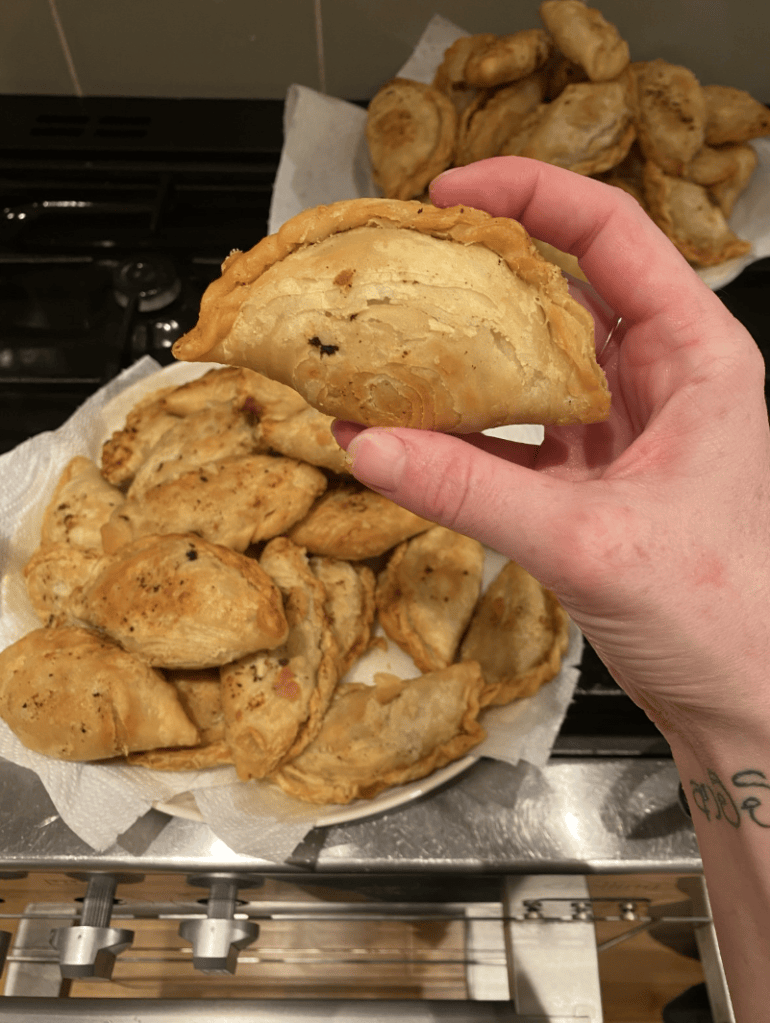
Last Christmas, I spent hours making karipap pusing, spiral curry puffs, perfecting the two different types of pastry required to make the beautiful flaky casings. I folded the dough with the precision of a surgeon performing a life-or-death operation, except it was just my own feeling of Malaysianness at stake. I needed to see Achi’s dexterity in my own hands. I felt if I could just pleat those semi-circles of curried potato and peas closed with the same deftness, it would confirm that my Malaysianness was still there.
I don’t know how many cooking hours I clocked up. After a year or so, my char kway teow, flat wok-fried rice noodles, and my satay/peanut sauce, started to resemble ones I’d had in restaurants. And I remembered how to cook a decent kapitan chicken curry from muscle memory alone. My nasi goreng was no longer overly starchy—the sauce was spicy, salty and sweet, all in one delicious dish. It felt like progress. Yet at the same time, it wasn’t fun and cooking felt like a test.
Shopping in Cardiff’s Asian supermarkets also became a key element in reconnecting with that part of myself. I retraced Achi’s footsteps in the Chinese and Indian grocers, wandering the densely packed aisles with pictures open on my phone. My husband trailed dutifully behind me while I scoured every shelf. I had to recognise what I needed by the items’ label colours or pictures, rather than the words.
Still, I’d be wondering and hoping that the staff could recognise I was actually a bit Asian too. I think I wanted to feel like I belonged there, or perhaps that my Malaysianness did actually belong to me, with or without Achi as my guide. I’d pick up sambal ranggup ikan bilis halus, or crispy anchovy chilli—because I’d definitely seen that in her fridge. And I did feel more Malaysian when I found the proper belacan, dried shrimp paste, because it’s the one smell that transports me straight back to Achi’s house. Probably like other (part-) Malaysians, I love its divisive aroma, while other people run a mile.
Slowly, I realised food smells, flavours and phrases had baked Malaysianness into me, probably since birth. Mee hoon, fried rice noodles, was my favourite childhood dinner on Thursday evenings at Achi’s; kuih bangkit were the biscuits from her Malaysia trips, because she remembered how much I loved them.
A few months ago, the cashier in the Asian supermarket asked what I was making with the bihun noodles I’d just picked up. Turns out she was from Penang, where Achi had been a nurse. She nodded knowingly when I said I was making mee hoon, without me having to explain. Together, we lamented the lack of decent Malay restaurants in Cardiff and she recommended her top London ones. Our interaction helped me realise food remains a shared language and means of connection—whether someone’s all of something or just a bit.
These past two years, it’s been a journey. I’ve had the comforting realisation that my Malaysian identity is still deeply ingrained in me—through food. This doesn’t mean I need to cook perfect Malaysian dishes just to prove my own identity to myself. It’s simply that food-related memories with Achi are what form my Malaysian heritage’s entry points; the little doorways back to myself.
I miss her every day. She was such a force to be reckoned with, it can still feel inconceivable to think she’s gone. But these days, I can remember her and celebrate my Malaysianness in two different breaths. I no longer feel the need to “collect evidence” as Michelle Zauner puts it that my identity wasn’t also lost when she died. It doesn’t matter if I’m copying how she’d chop spring onions into those diagonal cuts, or whether I give up on the elusive pecah minyak stage when the oil is supposed to split from the paste. These aren’t quantifiers of how Malaysian I am.
When I’m cooking, I can enjoy hearing Achi’s voice in my head, still reeling off ingredients I’ll never remember and feel connected to her on one level. But I can also feel bound to my Malaysian identity on a different level—as a connection I’ve defined myself. I don’t need to cook to prove it or claim access, because it’s already rooted within me. It’s in my blood. And like my memories of Achi, it’s something I can never truly lose.
Elin is a Welsh/Malaysian writer living in Cardiff. She studied English Literature at the University of Birmingham where she wrote for the university’s arts and culture blog. She’s now a content manager for the Civil Service, and a member of Cardiff Writer’s Circle. She loves reading and writing literary and historical fiction focusing on women’s experiences and has a deep interest in Malaysian history. She also runs a women’s social network and has hosted literary events with novelists and academic feminist authors. Elin has recently been longlisted by Welsh literary magazine, Folding Rock, in their creative non-fiction section.

