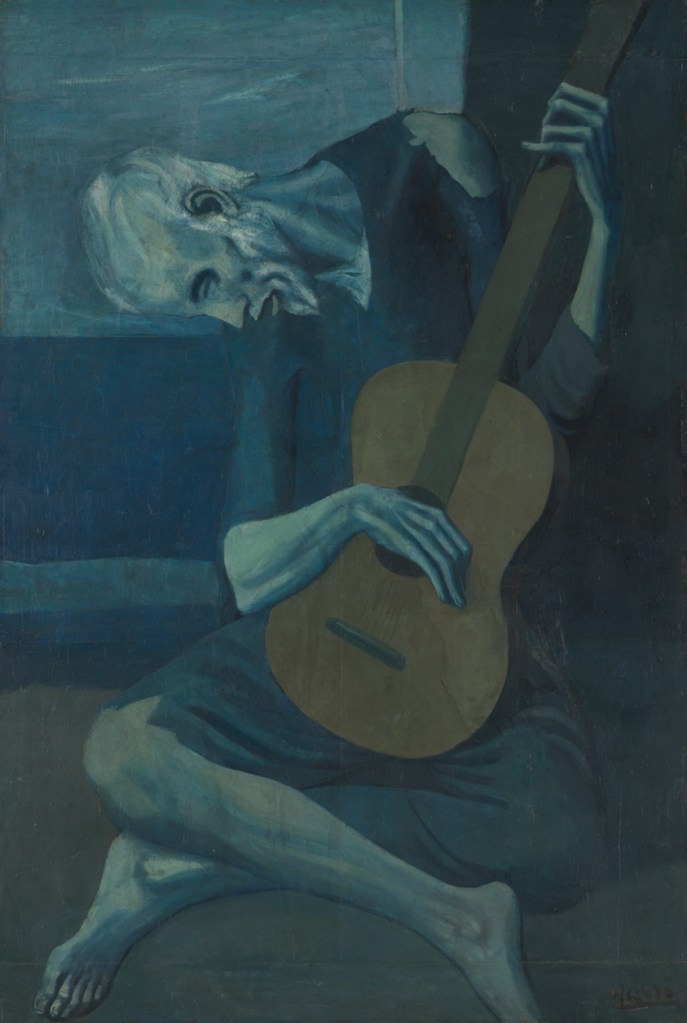
Pablo Picasso, Art Institute Chicago
On Melodic Kinship: Lessons from Big Bird and the Banjo
As a child, I remember music in all sorts of languages from many disparate parts of the world were played in our living room. They were played in the living room because it was the best space for dancing. I distinctly remember someone remarking once on how fascinating it was to see “those kids” move in ways highly reminiscent of the cultural dances tied to the music being played in our green suburban house in our green Boulder suburb. Somehow, without realising it, I was using music as a ferry boat, embodying the sounds and crossing from my home on one bank to the other, be it Yemeni villages, Moroccan souks, or South African streets. I claim no great intelligence here. Nor some kind of altruistic motive. I was just listening and moving and listening and moving. I’m no expert on what music does to the human brain. But there was something happening there. A child’s naive appreciation of sound. An unconscious sort of border crossing before learning about political boundaries or nations or what ‘culture’ meant.
Music has always been a cornerstone of my being. I genuinely don’t think I could understand myself or my family or my world without it. Now here comes the weird part–I never actually learned to play any instruments. I went through the torture of elementary school recorders and dulcimers like many a public school student in the US. I played clarinet for a couple years but was no great proficient. I didn’t sing. I mean I sang, but not in an organized or trained way.
My family was always quite musical though. My dad played clarinet and was my first teacher. My mom played a bit of recorder and guitar. My sister was always a true musician. Capable on piano, violin, viola, guitar. A genuinely beautiful singer. We always acted like she was the ‘real’ music person among us. But the truth is my mom always had a pleasing voice. And my dad is a genuine crooner. If you ever get the chance, convince him to sing some Elvis or Sinatra. You’ll be mesmerized. I’ll say of myself only that I’m not painful to listen to. But musical ability isn’t really the point. I’m a socialist because I was raised on folk music. Pete Seeger. Peter, Paul and Mary. Tracy Chapman. Woody Guthrie. Odetta. I’m really not exaggerating the importance here. If there’s a formula for raising red diaper babies I’m pretty sure it’s a banjo plus Big Bird.
When my sister and I are together, I’m afraid you’ll be subjected to us breaking into song, like, a lot. And a lot of those songs are gonna be from PBS Kids shows. And if our mom is there too, I’m afraid you’re in for a whole dinner theatre production. Sorry, not sorry. Most recently, the three of us and some of our victims–sorry, I meant friends–gathered for our annual socialist seder. This year’s attendees included two significant others, one school friend, one neighbor, one professor, and that professor’s nine-year-old. Half and half Jew/goy. And it was awesome. In part, because with the additional Jew not related to us, my family didn’t look totally insane when we sang all the songs, as though it was just some weird secret language we had. Someone else knew them too! These are melodies that connect us across time zones, across generations–there is something so special about being able to simply assume that a new person at your table will know the same songs. Or at least some of them. It is melodic kinship. Help yourself to whatever is in the fridge, you know where the plates are. And of course we made sure there were some rousing rounds of “Solidarity Forever” and “Bread and Roses” so the goys could join our kinship too. Welcome goys! Welcome to our revolution!
Those melodies function as ferry boats too. They take us from whatever disparate parts of the world we come from to this new space we make together. The seder is an excellent illustration of the ways my musical upbringing shaped the entanglement of my Jewishness and my politics. It is that entanglement made visible, like in the movies when the heisters use the special spray to show the spiderweb of laser beams (just go with me on this one okay?).
This year, I added a note at the beginning of our Haggadah, “On doykeit, or “hereness””:
Doykeit, from the Yiddish do for “here” and –keit, the suffix for “-ness” was coined by the Bundists in 1897 in opposition to Jewish Nationalism. It is a principle of “hereness” as opposed to “thereness”. It may seem a little ironic to frame this Haggadah with “hereness”, as the central theme of Passover is this great escape from Mitzrayim. But this is in part why we offer it now, to reframe the story as a diasporic as opposed to a nationalist one. And as Zionism makes Jews increasingly less safe globally, it is more important than ever to emphasize this idea.
So to alter the metaphor somewhat, it is Doykeit that is the ferryboat, carried by melodic kinship. The ferryboat is somewhat tardis-like in its abilities though, as it manages to traverse time and space through the wormholes that song opens up. Doykeit is the encapsulation of a spacetime that both collapses and celebrates distance. It runs a cord connecting the revolutionary present to an ancient past, honoring and even rejoicing in tradition. Simultaneously, it demands action towards a more just future. Doykeit seems to revel in toying with perspective. The concept itself is defined by its dynamism, but this definition shifts as we too change our relation to it.
For me, melodic kinship has always had this kind of doykeit-ed coloring to it, though I may not have had the vocabulary to name it as such as a child. But there was always a sense that these songs and melodies were joyfully rooted in both ancient tradition and one borne of only a few generations past. Something that spanned continents but still had a home where I lived. And also that these songs were a demand for justice. A call to action. The ferryboat was not a pleasure cruise, it was merely bringing us together so we could start organizing. I am certain Big Bird and the banjo would agree. Excellent band name by the way, someone should really use that. Big Bird and the Banjo would also admonish us to make sure our protests are always steeped in song. To grow our melodic kinship.
Note: A version of this essay was originally published on my substack
Maia Rosenberg is a linguistic anthropology PhD student at the University of Pittsburgh where she studies discourses of placemaking on the Jewish Left. Maia is a former political organiser and advocate for single-payer healthcare. She enjoys poetry as a medium to parse the world through humour, cynicism, anger, and whimsy. Instagram and threads: @maiapninaillustrations. Substack: @maiarosenberg

