On The Inheritance of Touch
I am an old crone in training. The kind of enigmatic woman who is the subject of neighborhood gossip whispered behind guarded lips. I practice for the role with some late-night pacing. Contemplation has proven to be one of the most ineffective modes of transportation, though. I estimate I’ve trundled thousands of miles, and still I’m yet to be delivered beyond the compounds of the left side-right side-left side of my living room. I’d be a prodigy of an upstairs neighbor if we didn’t live on the first floor. Heavy-footed, I torment my mother with my midnight recreation. It is not uncommon to receive a WhatsApp message from her pleading with me to trade the restive bit for sleep so that she might do the same. But it was under the spell of an August moon that she would succeed in bringing me to a standstill.
12:23 in the morning. I am Plato, the black teenage girl, as usual, stomping through a morass of introspection when I get the ping. I expected the foul card from Mom telling me to quit it before the rest of the apartment complex mobilized in front of our unit with torches and pitchforks in a Bolshevik-esque fervor. Instead, I read on my screen a single word: “Mashabe.”
Cryptic… Vague… I thought. Of the hardboiled detective beat. Following the black and white logic of a film noir, it made sense to pry the answer from the leading suspect. Padding over to her bedroom door, per genre conventions, I gave the furtive knock. It split ajar — a sliver of darkness from which emerged a pair of eyes, gaping wide and burning with owl-like discernment. It unnerved me. Not so much as to demur my need to know, “what is mashabe?”
My mother spoke with a legible glee, as if she, too, were dangling off a steep breath of anticipation, and we were to learn what she had to say together. She tempered her voice to a volume agreeable with the hour. A warm rumble.
“Mashabe is…” she said in a tentative start, “is kind of like intuition… they are visions… spirits… a trance.” She paused, finally deciding, “A gift.”
I brought myself closer to the door, folding my arms, dipping my head towards her, matching her sibyllic pitch, “Visions?”
“Yes, visions! They come in dreams.”
A matrilineal ability, it has been a genetic baton passed between Bemba mother and daughter in my family for as long as, if you choose to believe, the supernatural has been enmeshed in human nature. In those endowed with this mystical sensitivity, mashabe induces prophetic and visceral portents of the future that manifest in one’s dreams. It varies from individual to individual, but there are those for whom this prescience can be overwhelming. My grandmother had been afflicted terribly by the potency of her visions and was driven to seek the aid of a witch doctor to quell their intensity.
The community conjoined in rhythmic chants around a roaring fire pit. The echoes of incantations passed down through oral tradition. Herbs cooing the turbulence of roiling nightmares.
The operatic register of the scene my mother described nicked a nerve and paralyzed the body of my imagination. This impromptu discussion of hereditary woo-woo had enchanted me.
In her 1963 essay, Sartre’s Saint Genet, Susan Sontag coined the term “cosmophagy”: consumption “of the world by consciousness.” Quite apropos for how I devoured my mom’s revelation that precognition runs in our bloodline. It’s a reflex of mine to hunt for and feed on those things ripe with mystique as a means of nourishing my creativity. Self-evidently, I’m given to the dramatic, my neurosis being of the “perpetually working on a screenplay” variety. And in pursuing the chimera of a “writing career,” I’ve schlepped to the boondocks and back. It’s the perennial search for both CV fodder and opportunities for my “spiritual education.”
“Sustenance for the mind,” they call it, in pseudo-intellectualese.
Last November, it brought me to the Los Angeles Natural History Museum. All black. Slacks that had moral objections to my waistline. A dress shirt with a phobia of my wrists. My old marching band shoes given new life. I was there as a volunteer for KCRW, a public radio station based here in Santa Monica. In partnership with numerous film studios, KCRW hosts frequent and exclusive movie screenings as a perk for its paying members. That night was an advanced showing of director Chloé Zhao’s latest feature, Hamnet. I was there as an usher, checking in guests, handing out wristbands, pointing out the restroom. An evening of much horror for an introvert.
As a gesture of thanks for our dutiful assistance, we volunteers were offered reserved seating. Couldn’t miss it if you were blind: two rows quarantined from the rest of the audience, each seat labeled VOLUNTEER in impact font. Situated in the mezzanine, we overlooked the clambering bodies swarming into the theater, a somber melody swanning through the air in the interim before showtime.
I assumed my spot. The last wave of stragglers made touch down. The tossing and turning of the outside world abated. Hamnet began.
The metamorphosis brought upon by the cinema mimics what I envision an astronaut stranded in the unfalsifiable expanse of space must experience when she is hoisted into the mass of a black hole. Spaghettified, she becomes light and dark matter. Freed of the complications of flesh and allowed transmutation into the shape of a one hundred twenty-minute picture. In the pitch-black chamber of a movie theater, rises a sea of floating heads — bobbing like shadows against the forelight of the moving image.
We are all here to share in this. Willfully lulled by an illusion.
“A trance.”
But, inevitably, the hex is broken.
The lights turned back on, and a murmur of reawakening swept through the crowd. I let out a shuddery breath. The totality of what I had just watched, my heart clutched onto and made mine. The tears were hot and fat on my bottom eyelid, on the precipice of pouring over, and just begging for permission to fall. From the Earth to the sky — what has been given will be taken, and this is the map of our lives. The sadness after I’d watched Hamnet was not of bereavement. It was catharsis.
While I was still reeling from that emotional curb stomping, they brought out the chairs for the post-screening Q&A panel. Making an appearance were Zhao, production designer Fiona Crombie, costume designer Malgosia Turzanska, and co-editor Affonso Gonçalves. The gems of insight they laid out overwhelmed me. I didn’t know drowning could be so wonderful.
Turzanska spoke of Agnes’ dress, how it shifts from a sharper, vibrant orange into muddier desaturated hues, “like a bruise”, as opposed to when she’s pregnant, literally bursting with life, “an orange egg.” Shakespeare — William — shared a similar sartorial trajectory. Blues — navies and cobalts — blanched into a calcified gray until the final transformation at the end, where he dons a phantom white for his performance as the slain King of Denmark.
Whenever someone said anything that made the blood in my chest jet through my auricles, I nodded aggressively, pressed my hands together as one would do in prayer, and held them to a speechless mouth that, having been closed, could not have gotten any more silent, but somehow was padlocked shut.
Zhao recounted the story of her first Zoom call with Maggie O’Farrell, author of the 2020 novel on which Hamnet is based and co-writer of its screenplay. Zhao knew they would click as collaborators when O’Farrell cited Wong Kar-Wai’s seminal masterwork Chung-King Express as one of her favorite films.
“‘It’s the touch,’” Zhao remembers O’Farrell explaining, as the essence behind Wong’s allure. Zhao, reflecting on the exchange, extrapolated that to “hands.” What artists do with their hands. How she and her colleagues, through their hands, shaped the clay that was Hamnet into its ultimate form. How their creation was made into a conduit for gathering.
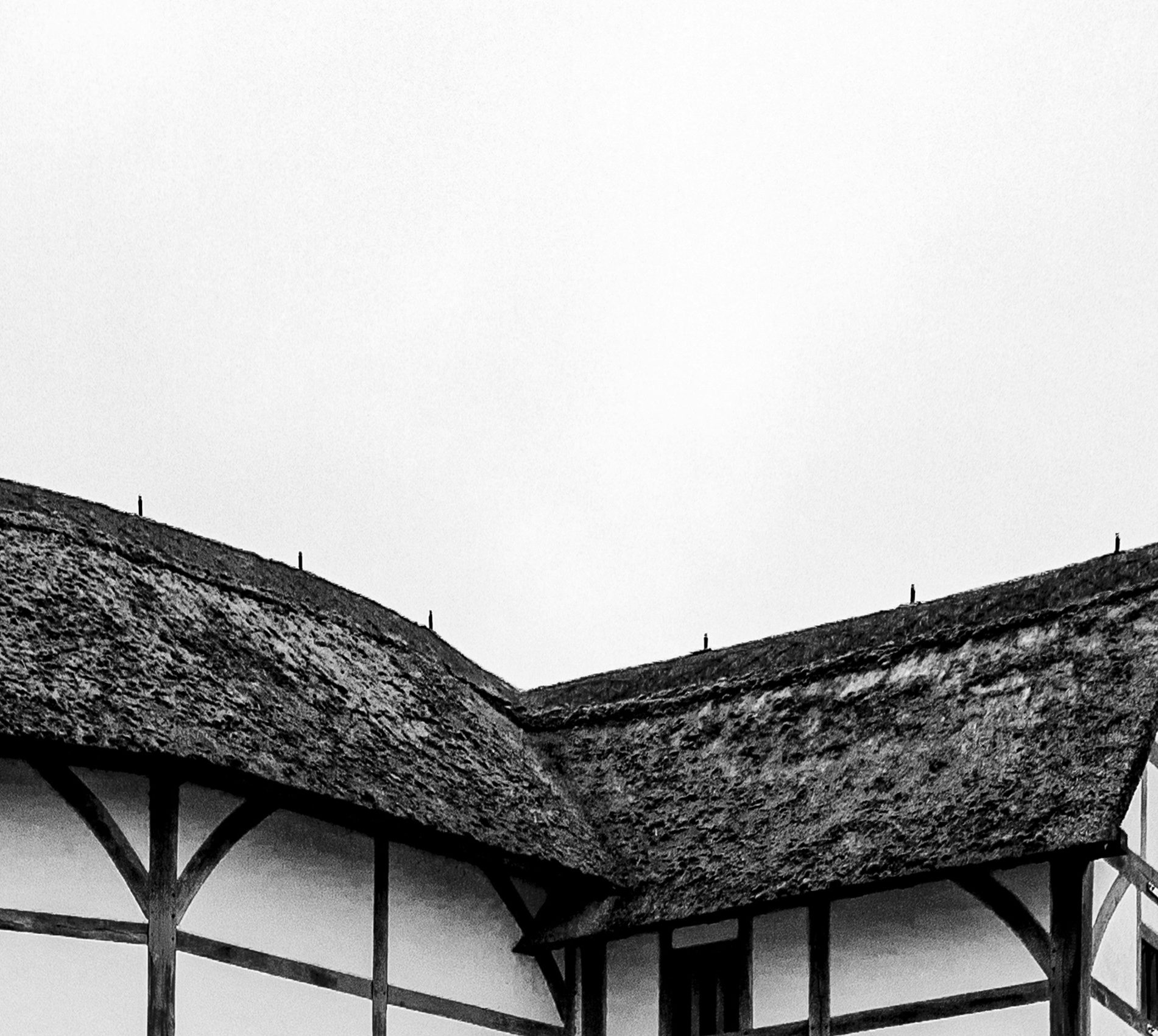
Laser-beamed into my mind, the final sequence of the film: The Globe Theater. Choked with the common man and woman who weep, as atop the stage a poisoned Hamlet retches out his last words for the record of history, “The rest is silence.”
But he is afraid to die.
Until Agnes, standing mere feet away from him, reaches out. Another in the audience follows her lead. And another and another more, until the hands of all assembled there unfurl like the petals of a spring flower to touch him.
“It’s the touch.”
It’s connection.
From my position practically in the ceiling, I out of anyone could see it. All of us. Together in that auditorium.
Cave paintings thousands of years ago — those hands on the walls — brought us here.
In a full four-hundred-seat venue, the hands of the creatives sitting in front of us had bound the disparate contingencies of our lives.
My soul vibrated at the frequency of an emphatic “Yes. Yes. Yes.” Haunted by this film, it’s a poltergeist I’ll happily welcome through my doors. Because it elucidated a concept integral to my calling as a woman of letters: The artist as a communal construction.
Artists, in their infinite variations, the writer, the painter, the director, the musician, etc., are vessels of emotion and tethers to humanity. Humanity constructs the artist by providing the facilities and materials for their work. However, pairing it down from the austerity of the H-word, it’d be more precise to say that it is mundanity that provides this material. Your inaugural breakup at twenty-two, a funny story that’s only funny to you and three other dumbasses like you, the time you got stuck in a toddler swing, and your useless demon of a cousin wouldn’t stop laughing. While the traditional image of the artist is of the cigarette-smoking hermetic locked to “his” desk — brutal, lonely, miserable work — I simply cannot buy the propaganda of pure solitude. Outside the very literal sense of the word, at least. Because when artists engage in the act of creation, they are channeling their community and experiences — other people — and delivering them onto their canvas of choice, as one would a vision. Be the misanthrope, sure, but it is undeniable: Others are our raison d’être. I mean, what the fuck else is there really?
Standing inches apart in that narrow hallway, my mother and I carried on with our pop-up coven meeting.
“For most, it really starts around this age. Your age. The older you are, the stronger they get.”
Wanting to orient myself within this lineage, this sorority of East African oracles, I asked her, “Do you think I might develop it? That I have it?”
She shrugged her eyebrows, “I don’t know,” she said, before considering it again, briefly, adding, “Maybe,” in a note that suggested she found whimsy in the uncertainty of the word, as if I’d invited her into a curiosity she hadn’t thought to venture herself.
Maybe.
My imagination had run franchises of inquiry with far less.
Parents being quick change artists in topics of conversation, she was now prattling on about matters of housekeeping: The trash needed to be taken out, there was a sink full of dirty dishes awaiting me in the morning, and “Turn off the lights in the living room. Go sleep. Stop making noise.” With that, having secured her peace, she was gone.
The night had the presence of a third body, a new inhabitant in our apartment that stowed herself away in the corners and the silence and the last few places we’ve allowed ourselves to weep and be stupid and be ugly and drink the poison that is desiring someone pretty to love us despite.
Maybe.
My bedroom door was the one directly across from hers. I opened it and walked in.
Maybe.
Malaika W. Kamau (author of If Orpheus Was a Carp) was born in 2006 in Lusaka, Zambia, but was a perpetual nomad throughout her childhood and adolescence as part and parcel of being an army brat. Today, Kamau manages her undergraduate coursework while moonlighting as a writer and aspiring filmmaker. Her work has appeared or is forthcoming in BRIO, The Corsair, The Dilettante, and Vagabond City Poetry.

