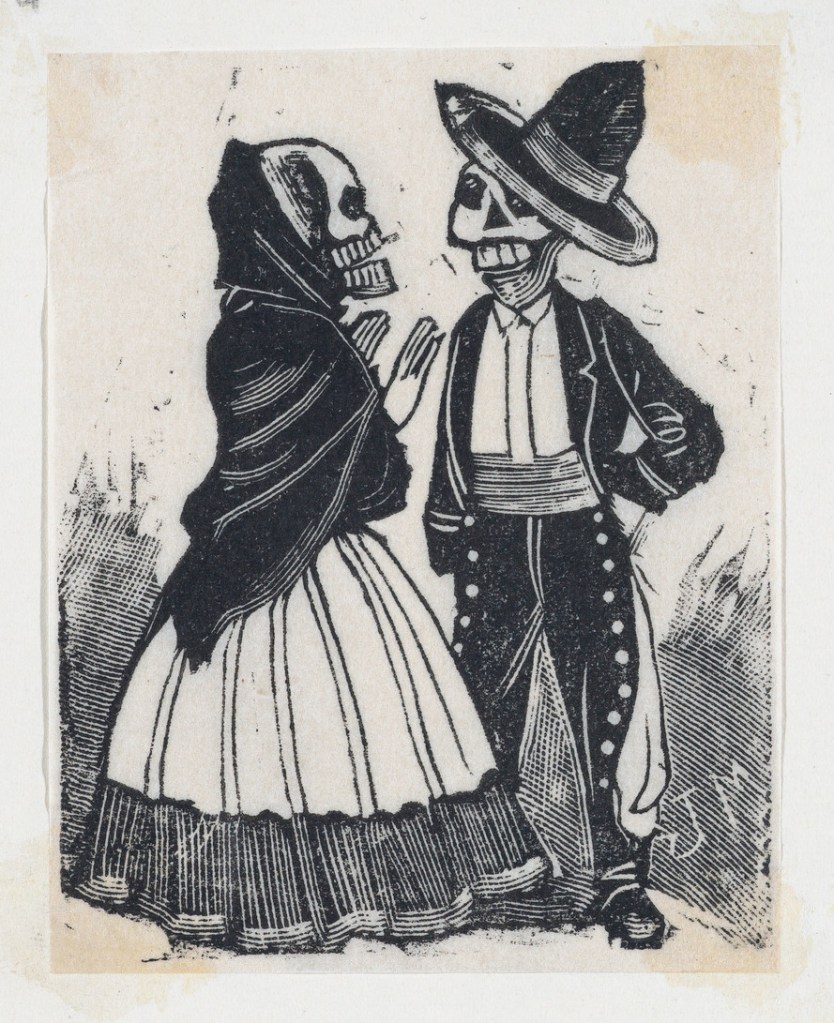
José Guadalupe Posada, The Met, New York
Corn and Chicken and Death and The Return
The fact that we’d never visited Mexico apart from a couple of long-ago weeks in Tulum, Yucatan might explain my scanty knowledge of El Dia de Los Muertos or the Day of the Dead. I knew it wasn’t connected to Ireland’s Samhain or All Hallow’s Eve, beloved in my childhood. I remembered that the plot of Malcolm Lowry’s virtuosic novel, Under The Volcano (1947), occurs over 24 hours on El Dia. In John Huston’s film adaptation of this novel (1984), in the opening scene we see ofrendas and skulls reflected in the sunglasses worn by the alcoholic protagonist, Geoffrey Firmin (played by Albert Finney). Firmin, Lowry’s protagonist who’s been symbolically dying for a long time, is ironically killed on the day the dead return to life, in a sense.
Jon and Cindy, friends who’ve lived many seasons, off and on, in San Miguel de Allende (SMA), Mexico, decided to invite a gang to celebrate Jon’s sixtieth birthday and El Dia, which falls a couple of days later. In SMA, about 150 miles northwest of Mexico City, you feel you’ve stepped into a small city somewhere in Spain or Italy. A large expatriate community thrives here. The climax of our week would be the traveling dinner on El Dia, hosted by food connoisseur, Victor Rivadeneyra. By the time we flew out of Mexico City, days later, I had finally watched the excellent Pixar Animation Studios Coco (2017, dir. Lee Unkrich), and El Dia made all kinds of sense.
Well, mostly.
The cosmology behind El Dia, the ways in which the holiday closes the space between we living and those dead we most loved (particularly family), let alone the deep ties between particular foods, ofrendas, and our painted faces, lends this sacred holiday a winning ambience. In SMA I came to love the way El Dia, with its painted faces and special foods, narrows the gap between being alive and being other and elsewhere.
Our friends had told us about the voluble Victor, a chef and guide whose calling is summarized in his epithet, “Guardian of Mexican Flavors and Traditions.” Originally from Leon, Victor spent formative years in Mexico City then moved to SMA twenty-five years ago. He ran a restaurant in SMA specializing in mole for seven years. In his autobiographical sketch, he’s “the founder of Unforgettable Culinary Traditions, a company based in San Miguel de Allende that currently offers six distinct culinary experiences and journeys.” Victor rides on a constant quest: “He travels to remote communities, learns in rustic kitchens, talks with those who have inherited ancestral knowledge, and immerses himself in the stories that live in every ingredient.”
In living abroad and traveling internationally across my life, I’ve come to believe that the quickest and surest ways into a foreign culture occur through food, drink, and music. Nothing original here. But Victor’s whole raison d’être affirms that credo. One that George Harrison, in “Savoy Truffle” on the Beatles’s White Album (1968), also confirmed: “You know that what you eat, you are.” If that’s true, we expand our identities, at least temporarily, by sampling new, “strange” fare. And on El Dia, what we eat and what we wear on our faces brings us much closer to the dearly departed who come back to visit this one night.
From what I understand, El Dia traditions, a complex weave of Mexican Roman Catholicism over sundry indigenous beliefs from many tribes in many regions, vary by locality. Lots of nuances and that’s fine by everyone. More than one guide mentioned that in Oaxaca, for example, observances look distinctly different from those in the much smaller SMA.
A few categories of those newly dead—children, mothers dying in childbirth, e.g.—ascend directly to heaven. Others plunge to the hot place. Most of us land in purgatory, turns out, and we might be there some while. When Victor describes the soul’s Journey, the details challenge the imagination. We’re told of thirteen ceilings and nine levels that the departed must navigate for this one-night return. He says that “in the pre-Hispanic worldview, the soul had to traverse different landscapes and challenges for four years after death to reach its final rest.” In his copious notes he subsequently shares with me, Victor elaborates: “each level [with its own name] represents a unique test that the soul must overcome, such as crossing a river guarded by dogs, passing between two colliding mountains, climbing an obsidian hill, traversing a field of icy wind and cutting gusts, and finally being attacked by stray arrows.”
That’s one long, tough journey, even for spirits, from Mictlan, the Aztec underworld.
Victor’s lengthy notes don’t explain those ceilings and rivers but elucidate his commentary during our itinerant evening. He defines El Dia as “a profound heartbeat, an ancient breath” that connects the dearly departed with the living: it is “organized memory,” “love made ritual.” Mictlan itself represents an extramundane journey, a sort of way station.
Supposedly, Mictlantecuhtli, the Aztec equivalent of Pluto who presides over the ancient Greek Hades, signifies “balance” rather than “terror.” However, the statue of him in Mexico City’s Templo Major Museum doesn’t re-assure you. The bilingual sign describes him as “a half-gaunt being in a position of attack, with claws and curly hair” and an exposed liver, the latter “closely related with Mictlan.” There’s something darkly comic about his flat jug ears, wide-lipped smile, exposed ribcage, and oversize hands and fingernails.
But Mictlantecuhtli fades from view as we gather at the Maison Mexique restaurant, just a few blocks east and uphill from SMA’s Jardin Principal or main plaza, to begin our culinary walk. For days, the city’s centro historico has been decorated: streamers and pennants waving across streets, vendors selling balloons and sweets, Catrinas smiling from shop windows or courtyards or balconies, and ofrendas outlining that central garden. According to Victor and other guides, ofrendas precede the Catholic concept of altars, as they’re specific to a family’s loved ones, like family shrines in Japanese homes. Victor reports that ofrendas “can have three, seven, nine, or even thirteen levels.” And each element (e.g. ubiquitous marigolds, or cempasuchil) has symbolic value as a bridge or map to guide the loved ones’ return.
The customized specificity of each ofrenda is highly appealing as is the notion that death means, as Victor puts it, “a luminous presence” and “visit,” “a living memory” rather than absence. That view, the ways in which El Dia collapses the absolute chasm between life and death, has much to recommend it. It’s the overarching theme of Victor’s voluble commentary. In Mexico, according to him, death is not an “end” but “a continuation,” “a luminous pause.” In this appealing worldview Atropos, the third Greek fate who cuts your life thread, signaling your death, loses some of her stern finality.
Certainly the tradition of Catrinas with form-fitting dresses and grinning skeleton heads—probably the most famous visual icon of El Dia— visually close the gap. Catrina first appeared as printmaker-illustrator Jose Guadalupe Posada’s satirical “La Calavera Garbancera” (1913), which a guide translated as “the woman selling garbanzos on the street.” Posada’s figure satirized upper-class sartorial pretensions as well as the bourgeois tendency to imitate European fashion to the neglect of native traditions. Later, Diego Rivera popularized “La Calavera Garbancera” in his 50’ fresco, “Dream of Sunday Afternoon in Alameda Park” (1947), christening her “La Calavera Catrina,” or simply “Catrina.” Catrina—grinning skull, plumed serpent boa, and belt buckle featuring the Aztec astrological sign of Ollin, according to online sources—stands just left of center and holds 10-yr-old Diego with her right hand. Elegantly dressed Posada stands immediately to her left, as though muralist-as-boy and satirist illustrator escort her.
We’ll all imitate Catrinas as part of our food journey.
Three couples gather, mid-afternoon, in a restaurant’s upstairs courtyard, a compact space, where several face painters stay busy with tubes, brushes, and tables. Ladies first. I step upstairs, enjoy beer and view with two friends, while Lynn, my wife, turns into a cat woman in whiteface. Pink and white beads festoon her eyebrows and two flowers adorn her cheeks and frame her black nose. When I finally take a seat, I ask the painter, “muchos colores, por favor,” no white base. Black frames my long face which flaunts a lurid spectrum from orange-red high on my forehead to bruised purple that curves beyond chin and jowls. Badass. Ready to welcome returning spirits though still unsure how my Goth look signals welcome. Three random tourists shout out to my Goth face, “Good job!”
We’ve never been to a masked ball but new faces lend a new outlook, sharp separation from our quotidian selves, as we sit at long tables in the Maison Mexique’s open courtyard. Painted faces give us permission to act differently, unloose the strings around regular identity—whatever that means. Waiters serve Night and Day soup, huitlacoche-and-corn-soup. Hard to catch all of Victor’s commentary as we quietly slurp. Tastes superficially like gazpacho though the two moons, one light and one dark, compose a simple geometry. This soup serves as “a reminder” and “declaration.” Victor relates that though “we are children of corn, beings of light” who “come from the day, from the warmth,” we need the rest and silence of night. Sound familiar? The archetypal diurnal duality, day and night.
He’s walked around the tables, showing an image of an ear of ripe corn, part of it covered by huitlacoche. Doesn’t enhance one’s appetite. But hey, what about mushrooms or ripe Roquefort or blue cheeses?
At our table we miss the interesting backstory of huitlacoche if Victor explained it. We chatter affably, strangers as friends. Before the arrival of Spaniards, it represented a rare “divine gift” from the annual corn harvest after the rainy season: “of every thousand ears of corn, only one would be covered with this black, soft, earthy, almost perfumed fungus” which was treasured as a harvest offering to the dead and to ensure a large, subsequent crop. The fungus signifies adequate rain at the right time for the crop, analogous to botrytis on particular late-harvest vinifera grapes. We spoon this soup that represents, like everything this night, a balance and bridge between worlds.
I pretend it’s not weird to be eating and drinking, wearing these painted masks. Why do we sit sedately and not cut loose? Will the colors around our lips smear?
At times during the next couple of hours, we walk like a class of primary kids on a field trip, carefully following the teacher. We don’t all hold hands but keep track of each other amidst the thick crowds shuffling along the streets.
At El Pegaso, our second restaurant, Victor talks well after we’re all holding our chicken tinga tostadas. We’re instructed to hold the tostada flat before us, thumbs and index and third fingers gripping its curved edge like prongs. Like a big communion wafer, cooked with chicken—a Spanish import—and chipotle, tomato, onion, and corn: Mesoamerican ingredients, we’re reminded. Victor also reminds us that chicken, an imported bird, signifies, in indigenous cultures, a messenger “from the world of the gods to the world of the living.” In a nice syncretism, eating a chicken tostada is a sacred act: “the hardness of the pre-Hispanic tortilla, the smoky chili that holds fire, and the bird that symbolizes the journey between worlds coexist,” he glosses.
Others grow restless and hungry, waiting out of politeness for the commentary to end before chomping. Then sounds of crunching bounce around the tables as we make short work of what we’ve been cupping for too long. My stomach feels more satisfied that it did after the Night and Day soup.
After a few blocks farther west, after crossing paths with the local parade, we sit in La Cocina del Viajero (“The Traveler’s Kitchen”) for chicken mole. Mole usually appears farther down on Mexican restaurant menus and your eyes must move beyond the blocks of tacos and tostadas and enchiladas and burritos and chimichangas and fajitas to find it. Occasionally I’ve ordered mole, feeling adventurous, but I sure didn’t know its complicated backstory. The two chefs, Lolita and Ramon, serve Oaxaca black mole, which Victor proclaims “an entire universe. . .on a single plate.” Good grief. But in a subsequent vote, most of us favor this chicken mole over the evening’s other courses. It more than compensates for the tart margaritas one of Jon’s old ski buddies generously ordered for those of us with a thirst.
In pre-Hispanic centuries, “mulli” was, as Victor narrates, “a thick, spicy, complex sauce made with chilies, seeds, wild herbs, and certain natural thickeners.” With the Spaniards arrived many additional spices. The resulting fusions taste rich on the palate—in this case, a happy merger of colonizer with colonized. Our guide waxes poetic: black mole is “duality made food” “a symbol of human complexity,” also “a ritual, a prayer, a conversation between worlds.” This feels like too much symbolic weight in the cooking pot. But this black mole tastes better than any I’ve ever eaten. As he says, “it’s not just felt on the tongue, but in the chest.” I agree.
Victor also claims, “you can sample any mole in any restaurant in Mexico or beyond, before ordering” because “you’ll find as many variations as there are Mexican restaurants.” I’ve not yet tested this theory out in our Montana town. But I love how this black mole stays on the savory side of sweet. Victor’s poeticizing its ingredients reflects this happy mixture of native with imported: “dried chilies toasted to the brink of darkness, seeds ground to a powder, breads that thicken memories, spices that traveled across seas and deserts before mingling here.” How “breads. . .thicken memories” seems elusive but because of my lifelong addiction to bread, I like it. Actually, the ways in which specific tastes unlock vast regions of one’s past validates this credo. When he asks us about mole’s key ingredient, some of us answer correctly. In his notes Victor calls it “that touch of dark, pre-Hispanic, ritual chocolate that doesn’t seek to sweeten but to deepen.”
We’re talking cacao, not chocolate as most of us crave it. Maybe more like baker’s chocolate.
My stomach does not forget this mole as we stroll north a few blocks to the Cafe Cayetana, where we crowd into an upstairs room, three tables triangulated to fit us. Here, Victor chronicles the gruesome history behind the enchiladas mineras (miner’s enchiladas) we’re served. The story focuses upon horrific child labor during the colonial period in nearby Guanajuato, near SMA and long a gold and especially silver mining center. He states, “twelve-year-old children. . .went down to work in a dark, damp, and lightless hell,” for five days at a time, “their life expectancy. . .barely seven years.”
For these children to survive a five-day shift beyond the “narrow, deep tunnels, pulled by pulleys and mules,” mothers or grandmothers created a durable enchilada. It’s built from (corn) tortillas, pickled vegetables “includ[ing] carrots, potatoes, onions, and chilies preserved in pineapple vinegar,” and salsa. The salsa consisted of dried chilies, mostly guajillo and ancho chilies, and later, red chili. These enchiladas didn’t spoil. In Victor’s fanciful contextualizing, they “gave light to those who lived the eternal night inside the mine.”
That’s a helluva story to digest with these enchiladas, but we blithely chew away. Ours are served with shoestring potatoes and topped with thinly sliced carrots. Current modes of child exploitation in impoverished regions around the world, e.g. sex trafficking, remind us that this notorious past history hasn’t passed away at all. Nor will it.
In this packed upstairs we’re also served one of the Day of the Dead’s most famous foods, pan de muerto (bread of the dead), baked by the Azomalli Artisanal Bakery. Before the humped, rounded shape of pan de muerto (flavored with orange zest or blossom) became commonplace, indigenes “offered small skulls made of amaranth and honey, decorated with fruit” to imitate facial features. Or they placed real skulls on the ofrendas. Like mole, many variations exist, but the basic shape includes a cross resembling bones, like hot cross buns at Easter, though the cross here carries other basic meanings (e.g. four cardinal directions). Atop the cross, a small ball of dough with sundry symbolic associations.
The cranial shape is all part of the welcome of ofrendas. We each carry a pan de muerto wrapped in an individual bag.
By now, stomach sated, my attention wanders from Victor’s ongoing lecture. It wanders further once we walk to the Day of the Dead Market. A mariachi band just finishes a set nearby. Victor calls our attention to a ubiquitous candy, alfeniques, “handcrafted with sugar, lemon, and sometimes egg white” and molded into dozens of shapes including “little skulls, animals, fruits, complete figures, crowns, colorful coffins.” Hard to concentrate on Victor when lots of other voices complete. He emphasized their sweetness, reminding us that the return of loved ones this night is not only a passage, but “a journey of love.” In this typically thorough exegesis, he asserts, “the lemon purifies, guiding the spirit with cleanliness and balance.”
Victor cautions, “if you pick an animal or human-shaped alfenique, eat it all before 11:00 or wait until after 6:00 a.m. Don’t just eat part of it because that will insult the returning spirits.” He invites us individually forward, and we grasp an alfenique, pop it into our mouths, say muchas gracias to our leader of the past two-three hours, disperse to our rooms.
But in ensuing weeks, my mind returns to this evening. While there’s nothing unusual about symbolic foods, this itinerant dinner with Victor as instructor has proven unique in my culinary experience. While details about Oaxaca black mole or enchiladas mineras or alfeniques fade, Victor’s emphasis upon “the beauty of remembrance” and each symbolic food functioning as a bridge—between the returning loved ones and ourselves—does not. These foods, like our painted skeletal faces, close the distance between the living and the spirits-who-aren’t-really-dead. Because El Dia de Los Muertos as annual tradition and institution ritually confirms the latter. Those we love most who’ve shuffled off the mortal coil do not disappear because of our formal and informal acts of remembrance. At the least they return one night a year and we celebrate them then, especially.
American society tends to forget, across the board. Despite the advice and example of such novelists as William Faulkner who famously declared “The past is never dead. It’s not even past” (1951), we encourage, tolerate, suffer from general amnesia. Focussed on the present and near-future, the past fades, even details from the lives of the dearly departed. I lose details about my parents who’ve been dead for decades. El Dia affirms the conviction that the dead live on, in some senses, and sustain palpable connection with us. El Dia with its painted faces and special foods closes the distance between mortality and a local, ubiquitous manifestation of immortality. If we are what we eat, those special dishes work like the specific food and drink offerings on the ofrendas. We taste and swallow, remember and draw closer.
If mortality constitutes our greatest fear—that crushing recognition, from an early age, that our life forms a fixed span with an end (Atropos)—El Dia consoles us with one powerful alternative. Though a nominal Christian, I’ve always doubted the reality of an afterlife, feared that death leads to a void. But through the lens of El Dia, I’m formally and informally remembered, and my spirit returns annually for one night amongst my younger, newer family. We have had two grandsons born recently. Well before their middle age, they’ll actively remember me.
I like that a lot.
On a recent evening my wife and I watched Coco again. This (Disney) Pixar Animation Studios production, which premiered at the Morelia (MX) International Film Festival (10/20/2017), has garnered several awards and very high praise from critics. While this is no place for detailed film analysis, a couple of features deserve mention. The bridge drenched in marigolds, the necessary flower, that the returning spirits cross during El Dia—if their photos have been placed on the family ofrenda—literalizes part of the journey back. It connects the realm of Purgatory—in this case, a fantastically thick urban Oz—with the realm of the living. Like the rainbow bridge in Richard Wagner’s Ring of the Nibelungs which the gods cross to Valhalla.
As the spirit of Hector, protagonist Miguel’s great-great-grandfather, a great singer-songwriter and mentor-guide, reminds Miguel and us, only if your extended family forgets you, do you fade away: “We call it the final death.” The counter to that fate, and the heart of the film, is the song, “Remember Me,” (“Recuerdame”) which Hector used to sing to his very young daughter, Coco, title character. We hear it a total of four times. Only two verses, it begins,
“Remember Me / though I have to say goodbye / Remember me / Don’t let it make you cry.” Remembering entails much more than grieving. It affirms our humanity, our niche on some family tree.
The Day of the Dead, the name of which sounds deadly, refutes the notion of final death. Specific foods serve as triggers, as folks like Victor Rivadernryra explicate, for “the beauty of remembrance.” Novelist Marcel Proust reminded us more than a century ago with his madeleine dipped in tea, which unlocks protagonist Marcel’s entire past and gradually unscrolls the ginormous septology-novel, A La Recherche du Temps Perdu (Remembrance of Things Past), that taste memory remains potent and acute across generations. Our tongues remember when our minds might not. At Christmas if I taste specific Norwegian cookies, I’m immediately back in my grandparents formal dining room, chubby kid, voices of many relatives floating above while I place too many cookies on my plate.
In Mexico, corn and chicken remind us that death should not be proud. Not only do we eat to live; we eat so that our dead relatives or close friends continue to live, so to speak, as well.
Alan Weltzien is a retired English prof based in Montana who travels a lot with
his wife. He has published a lot of stuff in the past 30 years or so. His five chapbooks and
eleven books include a memoir, A Father and an Island (Lewis-Clark Press, 2008),
and three full-length poetry collections, most recently On The Beach: Poems 2016 –
2021 (Cirque Press, 2022). More recent work includes a prose chapbook, The
Taylor Triptych (The Sea Letter journal, no. 12, winter 2024) and a poetry chapbook,
Into The Khumbu (Cirque Press, 2025). Forthcoming work includes a book of
travel essays, Walking Off Well-Beaten Paths (Cornerstone Books, 2027) and
another poetry chapbook, Suite Dolomiti (Bottlecap Press, 2026).

