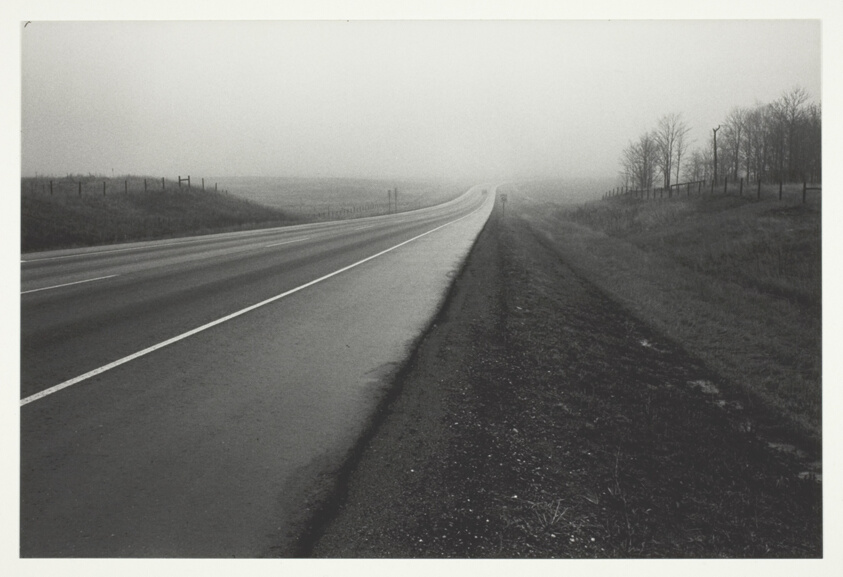
Mark Steenerson, Art Institute Chicago
Don’t Rattle Granny’s Bones
I am the daughter of a man with a TripTik. You may not know what a TripTik is, or you may understand it to be a triptych, a work of art made up of three panels, often hinged together in a sacred altarpiece. You may be thinking of scenes of the baby Jesus attended by beasts of the field or angels with the faces of men. But what my father possessed was genuinely a TripTik—an itinerary in strip maps held together by plastic rings, enabling the user to flip from one page to the next. My father acquired the itinerary, issued by the Automobile Association, to keep his family safe on the road. He was in that respect a conventional man.
My father was in most other respects his own man. He wore fuchsia and white stretch golf slacks and invested hours devising an architecture for the all-you-can-eat ice cream sundae: a wall of maraschino cherries with a mortar of chopped walnuts defending several scoops of rocky road. In the 1970s, he was neutral on teenaged girls engaging in premarital sex and disbelieved in the notion of “gifted children.” Although a physician, my father detoured sound dietary advice, at buffets pairing smoked salmon and potato salad with rum balls and Sherry trifle. To avoid stalled traffic, he often drove along the shoulder of the motorway for a mile or two and, as far as I recall, was never ticketed. In hospital, on his deathbed, he imagined himself to be on a beach in Florida.
My father died in November 2001, two months after 9/11, two days before the hydrangeas in the cemetery where he’d be buried were glazed in ice. As a young man indifferent to death, he called his parents by their first names: Simon and Malca. I call my driving instructor by his first name, but it’s no sign of familiarity.
“You may follow the marked route with confidence” specifies my father’s TripTik. Despite his tendency to flout convention, my father was driving from a young age, similarly expecting me, his only child, to do the same. Already in Grade 8, my composition topics at school included Lying, A World Without Electricity, and Learning to Drive. Yet only now, decades later, am I tentatively touching my foot to the accelerator. By submitting to the common practice of driving some 35 years later than would be usual, I’ve rendered myself uncommon. For me, learning to drive is a stepping stone to a modest achievement perpetrated by doing the right thing at the wrong time.
*
On my first lesson, my driving instructor tells me that if I can’t disengage the parking brake, I’ll fail the road test.
I might have replied with one of my father’s favourite sayings: “What happens to all the geniuses when they grow up?”
The instructor steers us into a cul-de-sac. “Sit in the driver’s seat,” he says. He positions orange pylons to the rear, front, and sides of the car. “Okay, tell me when you stop seeing the pylons.”
“Now!” I say, as they gradually disappear from view.
“Those are your blind spots,” the instructor says. “They’re big, and they’re dangerous. Don’t forget them.”
Towards the end of the lesson, I’m invited to advance the car by releasing the pressure of my foot on the brake. First, though, I struggle to disengage the parking brake.
“That happened to one of my students during the road test,” says the instructor. “She never left the parking lot.”
Over an hour and a half, I’ve advanced no more than several feet, seated beside a man whose teeth, gums, lips, nose, and chin I can only imagine. Both of us, in compliance with Covid protocol, are wearing masks.
*
My instructor doesn’t ask me why I’m learning to drive decades late, just as conventional cars could be superseded by self-driving ones. I don’t tell him how resistance to driving became a cornerstone of my identity as a nonconformist. I don’t tell him that in refusing to drive, I wilfully disregarded the route articulated by my father for his daughter’s life. I don’t tell him that a friend’s father, an artist celebrated for his depictions of lost streetscapes, had advised me as a younger woman how “driving could be a problem for sensitive people.” I volunteer instead, “My husband and I never owned a car before the pandemic.”
*
Michelangelo Antonioni said of his 1975 film The Passenger, the problem for the central character, Locke, is that he’s a journalist: “His job is always to talk about and show something or someone else, but he himself is not involved. He’s a witness, not a protagonist.” Synonyms for the word passenger include drifter, vagabond, transient, gadabout, laggard. In British boating slang, a passenger is a crew member who literally can’t pull his own weight; in the language used by South African farmers, a herd animal that fails in its duty to enhance the productivity of the group. A passenger implies the presence of more than one—at least one other to chart the course or bear the load.
My kindergarten teacher, in an early precis of my character, wrote, “tends to be more of an observer than a participant.” Although she didn’t interpret it as such, I displayed the makings of a passenger, also perhaps of a writer. Observation, arguably, is essential to the act of writing, as is the willingness to make and correct mistakes—to engage in multiple drafts. My father, a doctor, wasn’t versed in making mistakes, because in medicine a wrong appraisal can mean the difference between life and death. By virtue of his profession, my father was uniquely well equipped for the act of driving.
*
On my second lesson, my driving instructor tells me, “You ask too many questions.”
I might have responded, “A little knowledge is a dangerous thing,” one of my father’s most cherished aphorisms.
We’re in a near-empty supermarket parking lot, where I’m to ease off the brake, creeping to a solid white line. The line is flat and indestructible, but I approach it with the circumspection I would a helium balloon or a fledgling yellow-bellied sapsucker.
“Miles off,” the instructor says, as I brake well short of the target.
My instructor has no scent and neither does his car. He and I can detect odours through our masks, just as we can speak through them.
“What did I do wrong?” I ask.
“Don’t overthink it. And don’t ask so many questions.”
*
The road test I will eventually take is not the Driving Vengeance Questionnaire, is not the Narcissistic Personality Inventory, is not the Driver Aggression and Attribution Measure. All of those tests featured in a 2010 study, the object being to answer the question “Is an inflated view of the self a road hazard?” Men score higher than women on unchecked aggressive driving. We older novice drivers in contrast are renowned for our excess of caution, precarious self-confidence, and reluctance to assume control of the vehicle. Would we feel more plausible, I wonder, if we wore a dedicated outfit: flameproof underwear, a helmet, a balaclava, shoes with shallow lugs?
Unlike my father, I’m uncomfortable asserting my presence. Michelangelo Antonioni considered his actors to amount to little more than “moving space.” Or so said Jack Nicholson.
*
On my third lesson, my instructor tells me I am a “borderline erratic driver.”
I might have replied with one of my father’s best-loved expletives, “Don’t be such a goddamned fool.”
Remember, I have never accelerated. Now my passenger, a man with mostly undisclosed features, is ordering me to step on the gas, to stop, to signal, to turn.
I’m concentrating my vision forwards, my trajectory that of a predator chasing its quarry. And yet my sensibility at the wheel is in sympathy with prey animals—rabbits, frogs, deer—endowed with sideways vision to alert them to imminent danger.
“Cross the intersection. Now!”
I cannot do this and will not do this, but I am doing it.
“You’re veering left,” my instructor exclaims, and then, “You’re a borderline erratic driver.”
Later, the ordeal behind me, I compose my rebuttal: I am a learner driver and an older learner at that. You can’t reasonably expect me to display competence on one of the fastest and most challenging roads in the city. The underlying problem isn’t my aptitude but your expectations.
*
As a novice driver, I’m carrying in the back seat of my mind my own expectations, along with the rising contradictions they engender. I am my driving instructor’s vexation and myself. I am my father’s daughter and myself. I am a would-be driver. I am a continuing and willing passenger. When in command of the wheel, I am a question formulating an answer. Becoming a driver, for me, is not unlike being a writer. Each necessitates overcoming self-doubt and disbelief, becoming someone else.
I seek reassurance from a friend who has raised two well-rounded, accomplished children, both of whom passed their road tests. She forwards me this reply:
The hesitating in traffic is to be expected. Your perception of space and your response coordination have developed from the age of two in relation to walking and maximum running speed—a tenth of even slow residential driving! So, you are basically training like an astronaut, having to process and anticipate in a whole new way.
*
On my fourth lesson, my driving instructor tells me, “Let your eyes lead and your hands will follow.”
My father was seriously wounded only once in his life, during wartime, by shrapnel, when, by his own account, he “was spun around like a top.” My mother, herself never wounded in action, devoted much of her life to anticipating danger. Circumventing hazards is the subject of this lesson. I should do well.
“Go!” says the instructor, “and when I raise my hand, jam on the brake.” He clocks my response time. “Not bad.”
Now that we’ve entered the domain of theoretical risk, my instructor and I seem to be sidling towards compatibility.
“A child runs out in front of your car to rescue her ball from the road,” the instructor says, his tone dispassionate. “You’re driving 25 miles an hour and must come to an abrupt stop.” I glance in the rearview mirror, slam on the brakes and the car shudders.
“Your driving is okay,” the instructor says—the closest he’ll ever come to dispatching me a compliment—“but you’re too focused on what’s happening behind you.”
*
Once, on a family holiday to Florida, my father reversed 100 miles to recover a pink stuffed dog his little girl had forgotten between the sheets of a Howard Johnson’s Motel. His TripTik featured a “Trip Planning, Expenses, and Reservations” form, including advice to “list the objectives you expect to visit and apportion the time shown among them.” My father was to calculate “Total hours available” and “Hours allowable for driving, rest and lunch stops.” In fact, he left the planning section of his TripTik blank. “The thing is,” my father might have said, “I don’t need anyone telling me what to do.”
The youngest of three brothers, he struggled for self-determination. As I was growing up, even my father’s name, Archie, inspired mirth, recalling the comic book character Archie Andrews, a teenaged rhythm guitarist with orange hair and a red jalopy christened Ol’ Betsy.
*
My driving instructor and I never laughed together—not that I can remember. I suspect that he rarely, if ever, called me by name. But then one of the oddities of my driving lessons—one of the many respects in which they prompt me to breach the boundaries of my own character—is how my recall lacks precision.
In general, I’m endowed with a keen memory. Ask me what I ate in a Japanese restaurant pre-pandemic, and my hand will shoot up. Dragon Eye Futomaki! Quiz me on who, years ago, committed a murder in the board game Clue, and I have it: “Colonel Mustard, with a wrench, in the billiard room.” My ease with minutiae, arguably an asset for a writer, is far less in evidence when I take the wheel. That’s not to say that I’m missing the fundamentals of driving, but that I often struggle to recall the precise sequence of my lesson, along with the numerous instructions and pointers. More vividly embedded are the criticisms, so that my lessons, in hindsight, may resemble annotations without an underlying text.
*
On my fifth lesson, my driving instructor tells me, “Don’t expect a prize for making a lane change.”
The criticisms today are relentless: I haven’t paused long enough at a stop sign. I’ve brushed the kerb on my three-point turn. I’m driving too fast. I’m not driving fast enough. I’m not asserting my right of way.
As a little girl, I suffered a black eye because I refused to countenance a bigger boy pushing in front of me in line for the pinball machine. Justice, herself blindfolded, was nowhere present. My father was, and after treating the swelling with a cold compress, vowed to “give that kid what for.” If I were a sixteen-year-old girl, I might have been tempted to say to my driving instructor, “I’m going to call my father on you.” My father was strongly built, though gelatinous around the middle, with baby-doll pink cheeks and hard-to-read hazel eyes. He was older than most of my friends’ fathers, old enough even to be my grandfather. He’d faced down the Nazis on the beaches of Normandy. He filled my candy cupboard with Whoppers and Jawbreakers. My father would never have let me come to harm.
*
In July 1929, just months before the stock market crash and the Great Depression, Rose, my maternal grandmother, was photographed relaxing against the front bumper of a convertible, modish in cropped trousers, a sleeveless top, a polka dot neck scarf, and pointy-toed shoes. Both she and my paternal grandmother were lifelong passengers, belonging to a generation of women who derived comfort and exuded pride from sitting alongside their brothers and husbands commanding the wheel.
Our sense of identity is understood to be collaborative, generated not merely by how we rate ourselves but also by how others perceive us. We women traditionally were defined as passengers and in some non-Western countries still are. Like my pink stuffed dog stranded between the sheets, we lacked the agency to specify the way ahead.
In his film The Passenger, Michelangelo Antonioni reportedly intended that the actress Maria Schneider’s character should drive Locke’s car in one of the key scenes—until Antonioni found out last minute that Schneider didn’t drive.
*
On my sixth lesson, my instructor tells me not to stop the car to make way for small animals.
“Use your horn,” he says. “They’re not stupid.”
“Okay.”
“Stop saying ‘okay’.”
The rules are clear,” my instructor elaborates, “small animals may enjoy the use of the road, but they don’t have right of way.”
I would like to respond that this first premise—how compact animals matter less than larger human beings—entails a judgement about the value of life. I would like to say that the contest between a squirrel and a vehicle is inherently unfair, underlining the cruelty and randomness of fate. I would like to emphasize that in some understandings, a squirrel and a human being are merely points along a continuum, each a vessel for the same soul. I would like to add that my father revered squirrels. But I say nothing, because I’m the one at the wheel, responsible both for myself and the instructor, along with the black squirrel about to flip the bird to the rules of the road.
*
Wanton killing is prohibited in many religions. This is something that religion and driving have in common. I am not observant, but in Judaism, my inherited religion, driving is specifically prohibited on the Sabbath. Kindling a flame, according to the Mishnah, the Jewish compilation of oral tradition, is a form of labour forbidden on the Sabbath because it recalls the construction of the Tabernacle in the wilderness, when rest was imposed on the seventh day. The relevance to cars? An internal combustion engine burns gas, and burning gas is akin to lighting a fire.
The role of a passenger, as it turns out, imparts nearly as much culpability as assuming the wheel. The reasoning is simple: The extra weight of a passenger is said to cause the car’s engine to burn more fuel.
I have felt during my lessons that both my parents were sitting in the back seat enjoying a kind of automotive Sabbath, gratified finally to be relieved of their responsibility as my drivers. My mother herself was a capable driver who transported her refusenik daughter everywhere, except to driving lessons.
*
My father’s TripTik, dated 1991, details a proposed itinerary from Montreal to Washington, DC. Both my mother and my father had travelled those roads before, when driving to Virginia Beach, on their honeymoon, in 1955. In the passenger seat was my mother, 17 years her husband’s junior—a comely brunette, attired in a blue and white tweed suit and topcoat with a white straw hat and a corsage of white orchids. Thirty-six years later, my father was re-enacting the 600-mile drive, on this occasion to visit me and my husband at our apartment in Washington, and same as my parents on their virgin drive to D.C., my husband and I were newly married. My father’s TripTik, with no mind of its own and no capacity for recall, thus commemorates two beginnings.
*
On my seventh lesson, my instructor tells me that my narrative is unclear and not necessarily correct.
I might have said, “Shut the hell up,” one of my father’s stock retorts.
The instructor’s alluding to the habit I’ve developed of describing what I’m going to do just as I’m about to do it—a way of encouraging myself in the absence of affirmation from him.
“Okay,” he says, “let’s do a kerbside stop.”
“I’m about to do a kerbside stop.”
“You didn’t stop!”
I point to the familiar spot where, invariably, we’ve practised this slow manoeuvre. “I thought you wanted me over there.”
“Did I tell you that?”
No, I tell myself, but nor did you direct me to the contrary.
“Sorry.” I say, without meaning it and loud enough to expel the syllables through the triple wadding of my mask.
Several of my friends with pedagogical training are aghast when I relate the substance of my driving lessons. In neglecting to provide encouragement alongside criticism, the driving instructor is exhibiting a failure of self-control. I might legitimately have said to him, “You talk too much.” Instead, I compose myself with one of my father’s most revered maxims, “Every exaggerated reaction is a mask for a person’s defects.”
*
“Do you want to be sick?” my father asked my mother with no ado as we were irrefutably lost in the crater of Mount Teide, an active volcano on the island of Tenerife, nightfall imminent, my father plying himself with Imodium after gorging on lukewarm prawns at the hotel buffet. He occasionally on family holidays dispensed with maps, relying instead on his instincts. Despite his indisposition, my father would never let my mother, a one-time driver of a convertible, assume the wheel.
Earlier, as my father had persisted in taking what were obviously a series of wrong turns, I put to him a simple question, “Are you lost?”
Jewish learning is interrogatory. The Old Testament is rife with exchanges of questions and answers on mountaintops, some of them prompting a rebuke from an angry and vengeful god. My father’s reply to his daughter’s question on Mount Teide was similarly swift and reprimanding. “I’d never marry a woman like you.”
*
In the book Lost and Found, Jules Montague questions the authenticity of memory: “when you remember that moment, you are not really remembering that moment. Instead, you’re remembering the last time you remembered it—retrieving what you recalled before and infusing that memory with the experiences and perceptions you’ve gathered since then.” I remember my mother recalling how my father wouldn’t let me cry in my crib because he wanted to instil in me that “the world was a friendly place.” I recall my father relating how there is such a thing as “sympathetic blindness,” when a single eye that is wounded or blind later imparts the same affliction to the other. I remember my mother remembering how she took to her bed for weeks after the sudden death of the puppy she adored—a miniature French poodle. My father, not wanting to curb the dog’s freedom, let him run off leash in a farmer’s field. The dog was hit by a car.
At the end of my father’s life, when his memory had failed and he needed to reconstitute his picture of who I was, he asked me several questions: Were my husband and I of many years planning to get married? Were we planning to have children (we hadn’t)? Would we like him to buy us a bigger TV set (he already had)? Never did my father ask whether I’d learned to drive.
*
As a little girl, one of my “big words” was verbose—a word that my father used of my mother and my father’s father of my father’s mother. “You go on and on,” my father not infrequently said to my mother, “You just can’t stop,” whether the subject in question was my father’s allegiance to his Hair Whiz or the allure of a condo building whose atrium mimicked a tropical rain forest. No doubt my father had been confronted all day with his patients’ complaints of heartburn, impetigo, and ingrown toenails, and so in his leisure time was partial to silence and playing nine holes of golf or gin rummy. Nonetheless, as I grew older and became susceptible to Helen Reddy, I began to consider his rebukes to my mother unfair.
Occasionally I intervened. “Stop talking to her that way.”
There were just the three of us, my father outnumbered by two women. The habits of speech and intolerance he’d learned and cultivated from childhood in a household of three boys led by a powerful and strong-willed father couldn’t stand. My father’s steadfast love for me was never in question. In turn, I adored him for his courage, his fierce loyalty to his family, his devotion to the infirm, his defining trait of always making up his own mind— but I vowed never to let a man speak to me the way he did to my mother.
*
“Don’t rattle Granny’s bones in the back seat,” my driving instructor tells me as I ease on the brake approaching a red light. I don’t dare to say “Okay,” a word most often considered unnecessary to suppress.
We routinely are expected to hold our tongues—as children in school, as adults in the theatre, when in hospital zones or beside slumbering infants. Only more rarely, in hide and seek, or cataract surgery, do we legitimately cover another person’s eyes. Or on The Price Is Right or other game shows before the prize of a Cadillac is unveiled and the contestant—in all probability a woman—erupts into tears.
A mask is not a gag—not by design. The mask never comes off during my driving lessons. The blindfold, never present, is lifted as the lessons conclude. Only then do I register that the man beside me, to my mind a stranger, is someone I already know.
Sharon Kirsch is the author of The Smallest Objective, a mother-daughter memoir and winner of a Vine Award for Canadian Jewish Literature. Her earlier book of creative non-fiction, What Species of Creatures, was inspired by historical writings about unfamiliar birds and “beasts.” Sharon’s flash prose and essays have appeared in The Washington Post, The Los Angeles Times, Terrain, The Ekphrastic Review, Panorama: The Journal of Travel, Place and Nature, and elsewhere. A former Commonwealth scholar, she studied Middle English literature at York University in the UK and spends time each year in West Dorset. She is currently based in Toronto.

